BITSAT 2016 Memory-Based Questions (Physics and Chemistry)
BITSAT
Memory-Based2016BITSAT 2016 previous year questions as remembered by candidates after the online test: 30 Chemistry and 21 Physics questions, without an answer key.
BITS Pilani does not publish BITSAT question papers. This paper is built from questions candidates remembered after the exam, so treat it as practice in the BITSAT style rather than a copy of the official paper.
About this paper
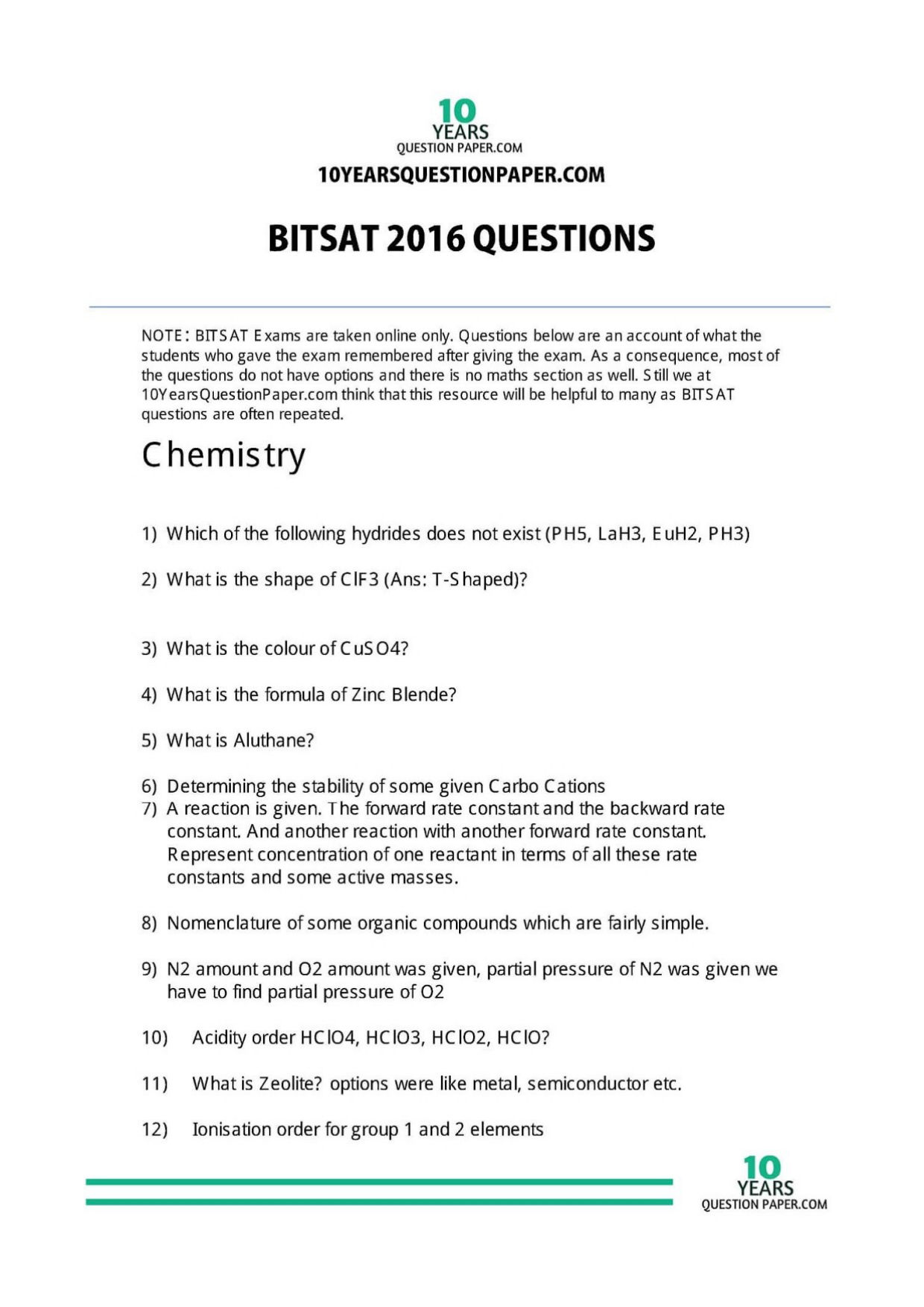
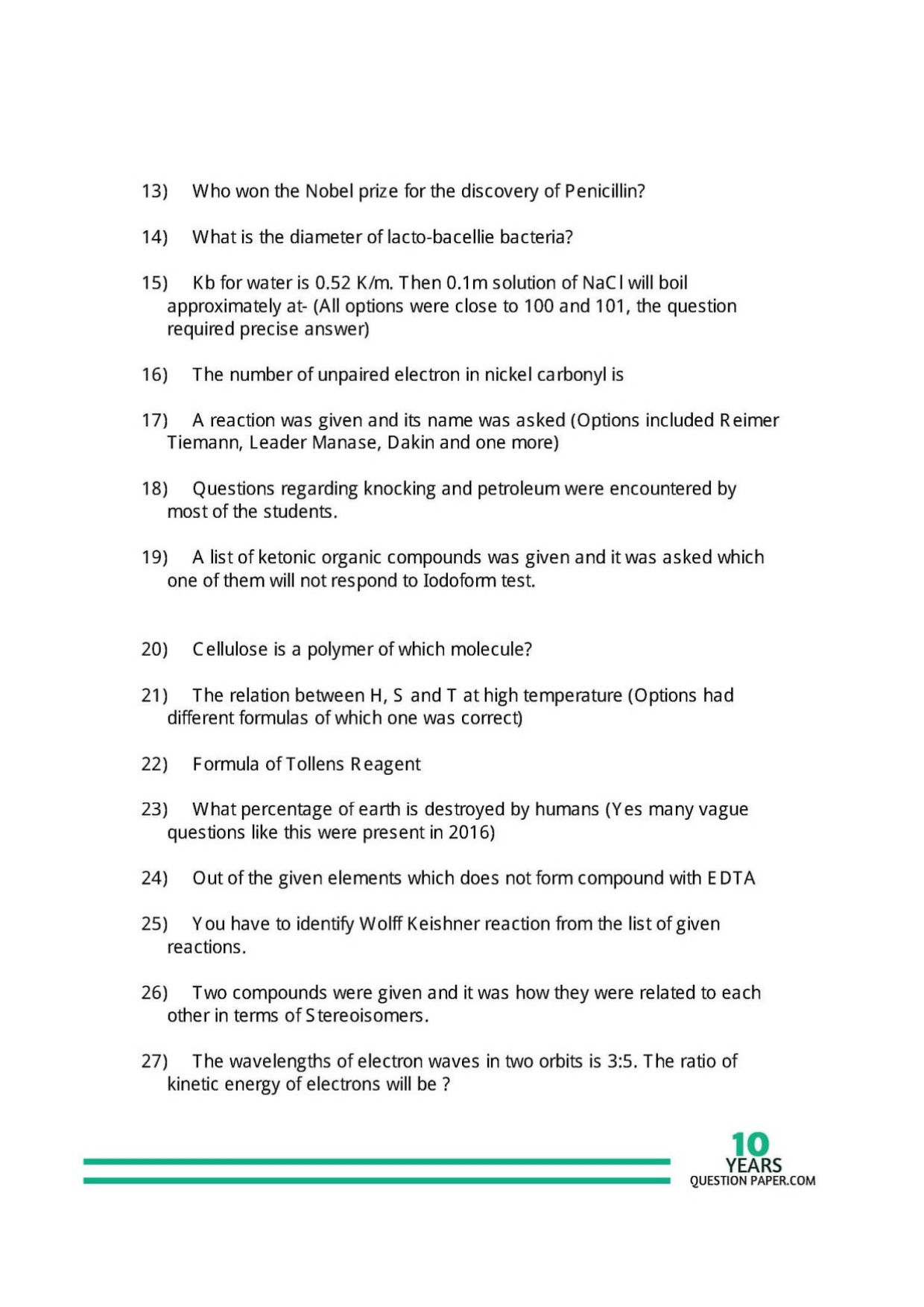
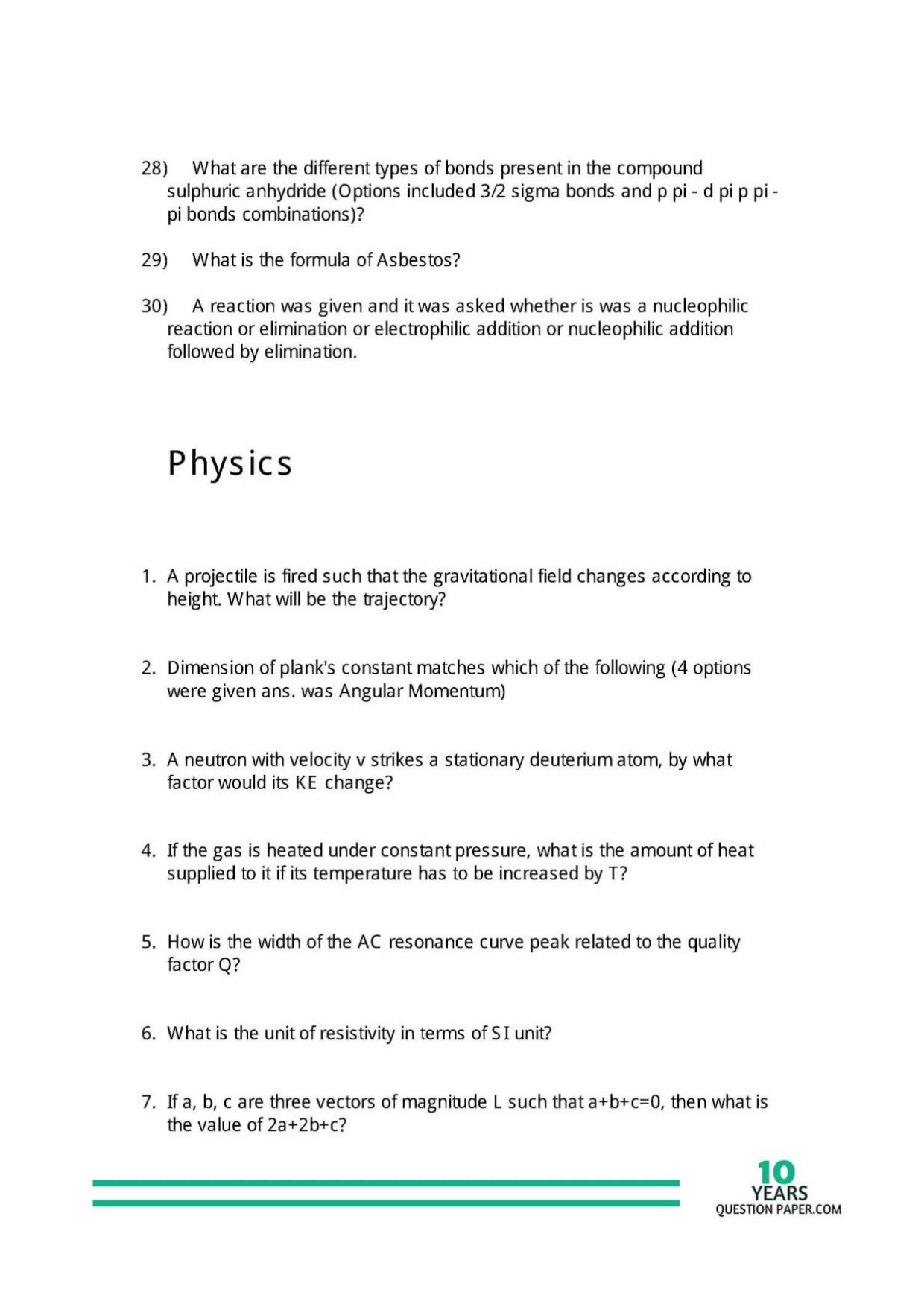
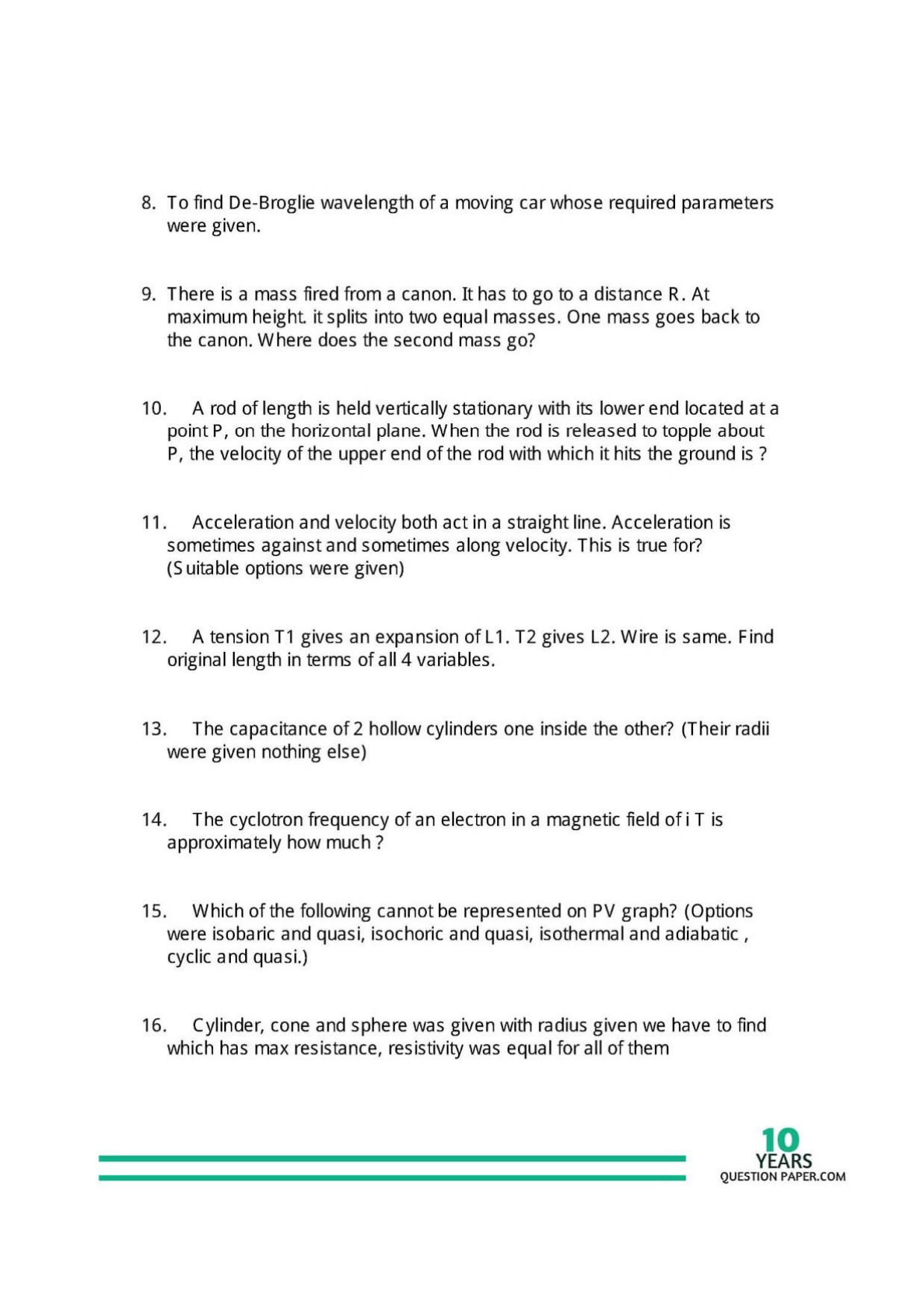
This is a record of the BITSAT 2016 questions that candidates remembered after sitting the online test, compiled by 10 Years Question Paper. BITS does not publish BITSAT papers, so no official copy exists. The record covers 30 Chemistry questions and 21 Physics questions; options are noted only where students recalled them, and there is no Mathematics, English or Logical Reasoning section and no answer key. Use it to see which concepts came up in 2016, not as a timed mock.
- Exam
- BITSAT
- Subject
- Memory-Based
- Year
- 2016
- Questions
- 51
- Pages
- 5
- Answers included
- No, questions only
Paper pattern
Chemistry
Questions 1–30, recalled by candidates
Physics
Questions 1–21, recalled by candidates
Topics covered
- Chemical bonding and molecular shape
- Colligative properties
- Coordination compounds
- Organic named reactions
- Stereoisomerism
- Atomic structure
- Mechanics and collisions
- Thermodynamics
- AC circuits and resonance
- Nuclear physics
- Surface tension
Questions from this paper
- What is the shape of ClF3?
- Kb for water is 0.52 K/m. At approximately what temperature will a 0.1 m solution of NaCl boil?
- How many unpaired electrons are there in nickel carbonyl?
- The wavelengths of electron waves in two orbits are in the ratio 3 : 5. What is the ratio of the kinetic energies of the electrons?
- A neutron moving with velocity v strikes a stationary deuterium atom. By what factor does its kinetic energy change?
- What is used to slow down fast neutrons?
Free email alert
Get the 2027 BITSAT papers first
One email when the new BITSAT Memory-Based question papers are published here. No spam, unsubscribe any time.
What's next
Thinking about what comes next?
Scholarships, education loans, and study-abroad costs, explained with real numbers.
See guidance