CBSE Class 12 Physics Question Paper 2020 with Solution

CBSE
Physics2020CBSE Class 12 Physics (Theory) question paper from the 2020 board exam (code 55/3/1): 37 questions for 70 marks in 3 hours, with MCQs. No solutions.
Practice these questions to improve your performance in the board examination.
About this paper
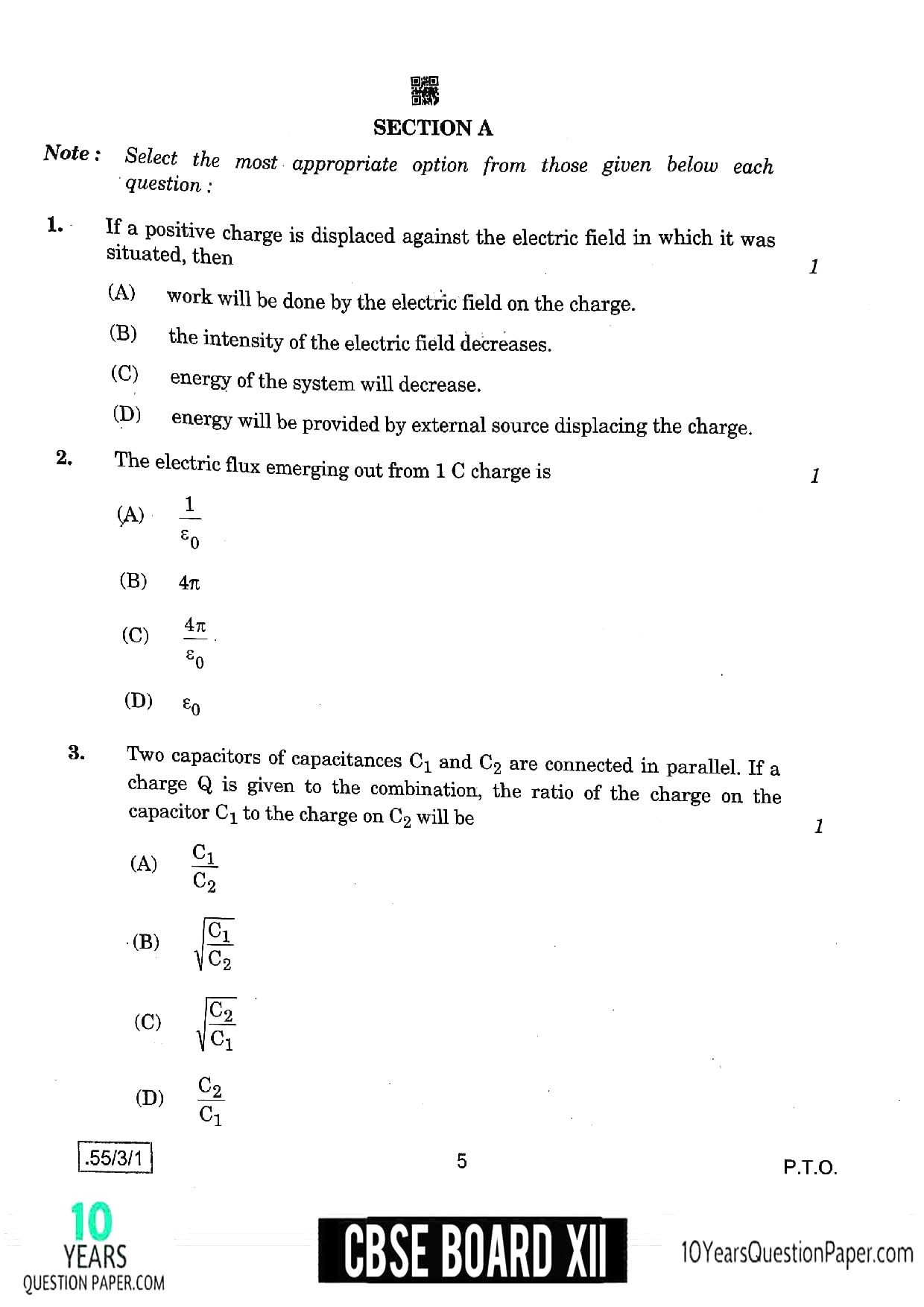
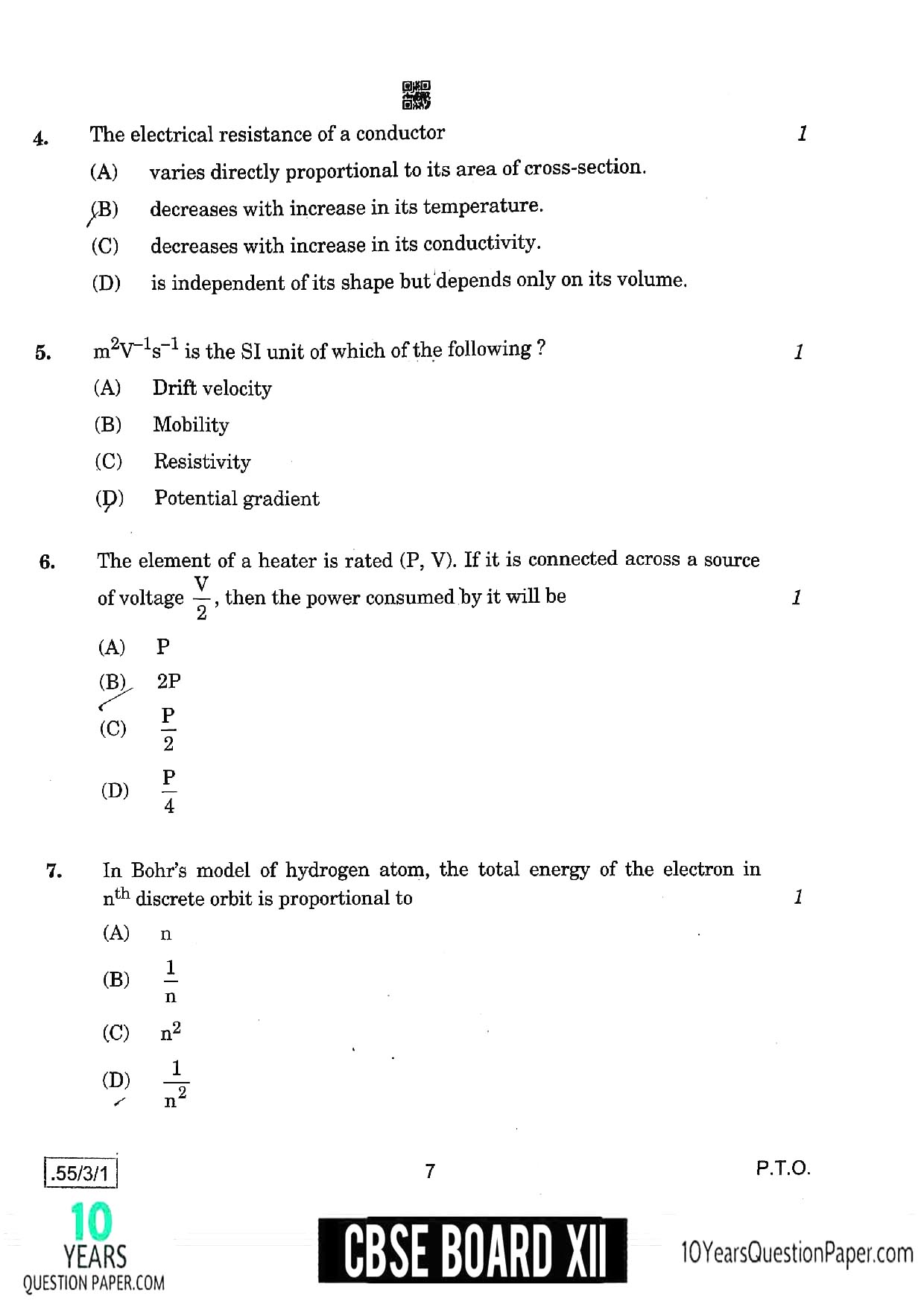
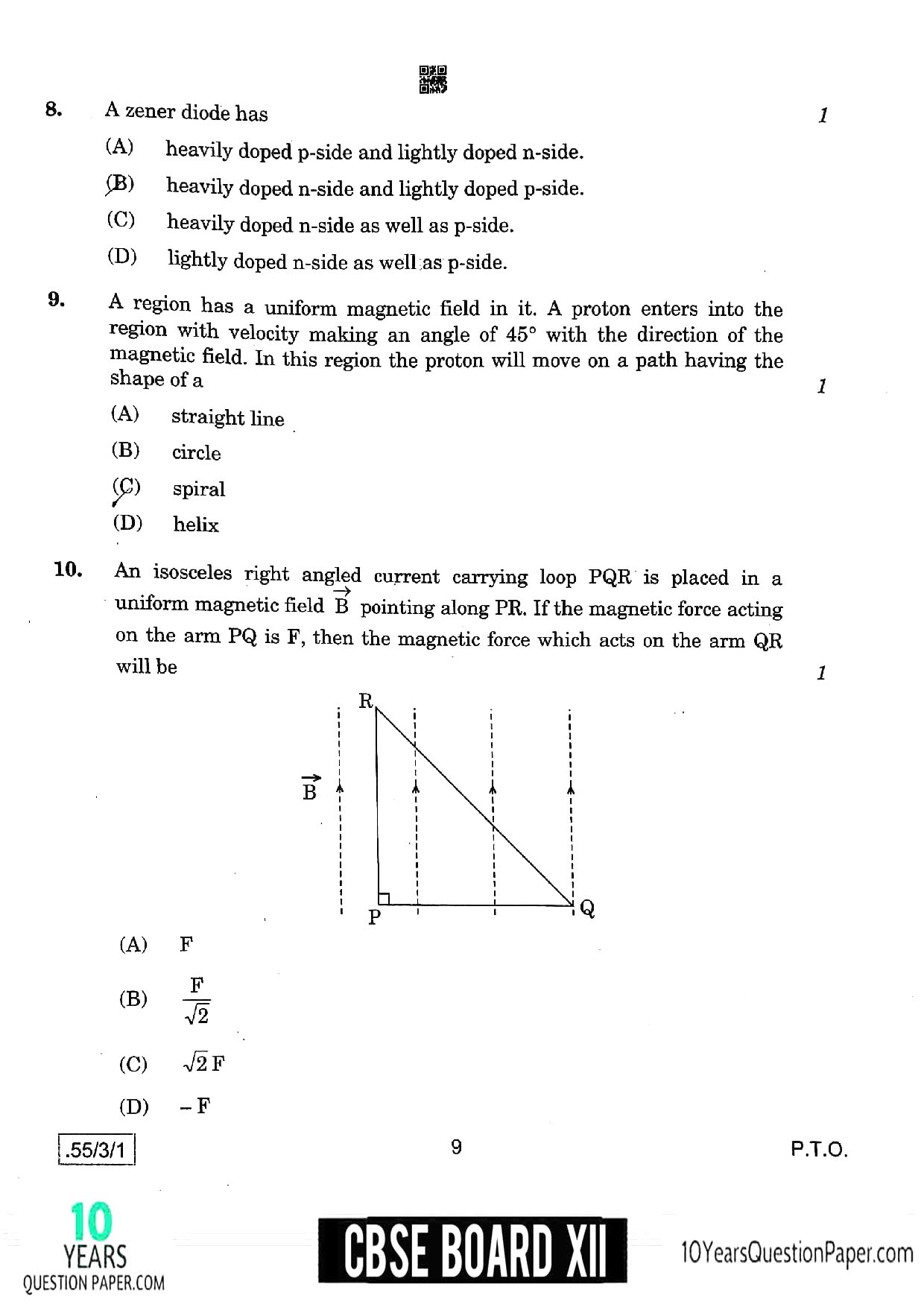
This is the CBSE Class 12 Physics (Theory) question paper from the 2020 board examination, Series HMJ/3, Set 1, code 55/3/1. It carries 70 marks over three hours and has 37 questions in four sections. Section A has 20 one-mark questions: ten multiple-choice, five fill-in-the-blanks and five very short answers, one of them on J.C. Bose's contribution to producing electromagnetic waves. Section B has seven two-mark questions, Section C seven three-mark questions and Section D three five-mark long answers. Several questions, including all three in Section D, offer an internal choice. The paper covers electrostatics through to semiconductors, with numericals on LCR resonance, potentiometers and parallel conductors. This copy has the questions only, with no solutions.
- Exam
- CBSE Class 12
- Subject
- Physics
- Year
- 2020
- Paper code
- 55/3/1
- Maximum marks
- 70
- Time allowed
- 3 hours
- Questions
- 37
- Pages
- 9
- Answers included
- No, questions only
Paper pattern
Section A
20 marksQuestions 1–20, one mark each: 10 multiple-choice, 5 fill-in-the-blanks and 5 very short answers
Section B
14 marksQuestions 21–27, two marks each
Section C
21 marksQuestions 28–34, three marks each
Section D
15 marksQuestions 35–37, five marks each, each with an internal choice
Topics covered
- Electric charges, fields and dipoles
- Capacitors
- Current electricity and potentiometer
- Moving charges and magnetism
- Magnetism and matter
- Electromagnetic induction
- Alternating current and LCR circuits
- Electromagnetic waves
- Ray optics and optical instruments
- Wave optics and polarisation
- Dual nature of radiation and matter
- Atoms and nuclei
- Semiconductor devices
Questions from this paper
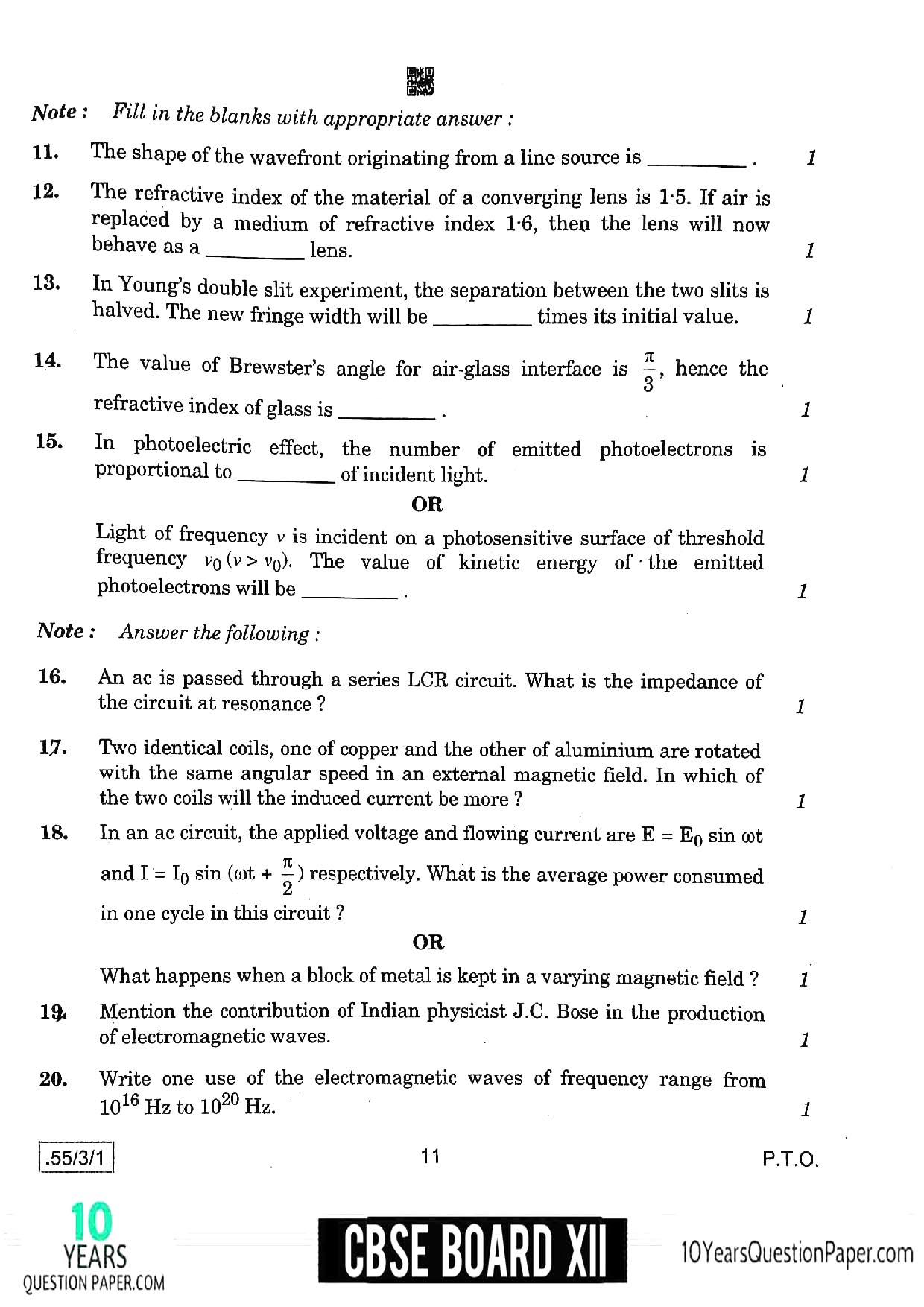
- Mention the contribution of the Indian physicist J.C. Bose in the production of electromagnetic waves.
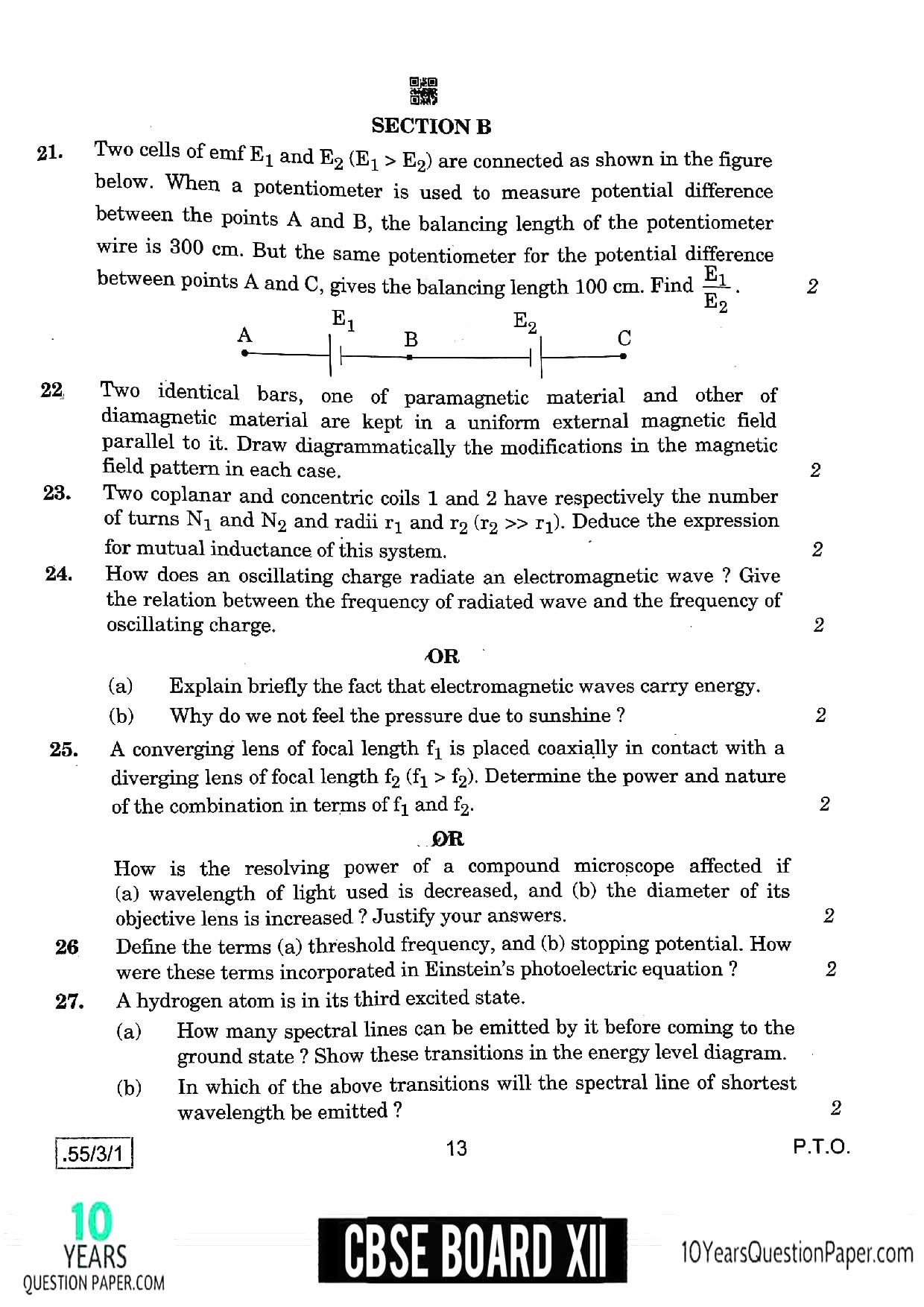
- A hydrogen atom is in its third excited state. How many spectral lines can it emit before coming to the ground state, and in which transition is the line of shortest wavelength emitted?
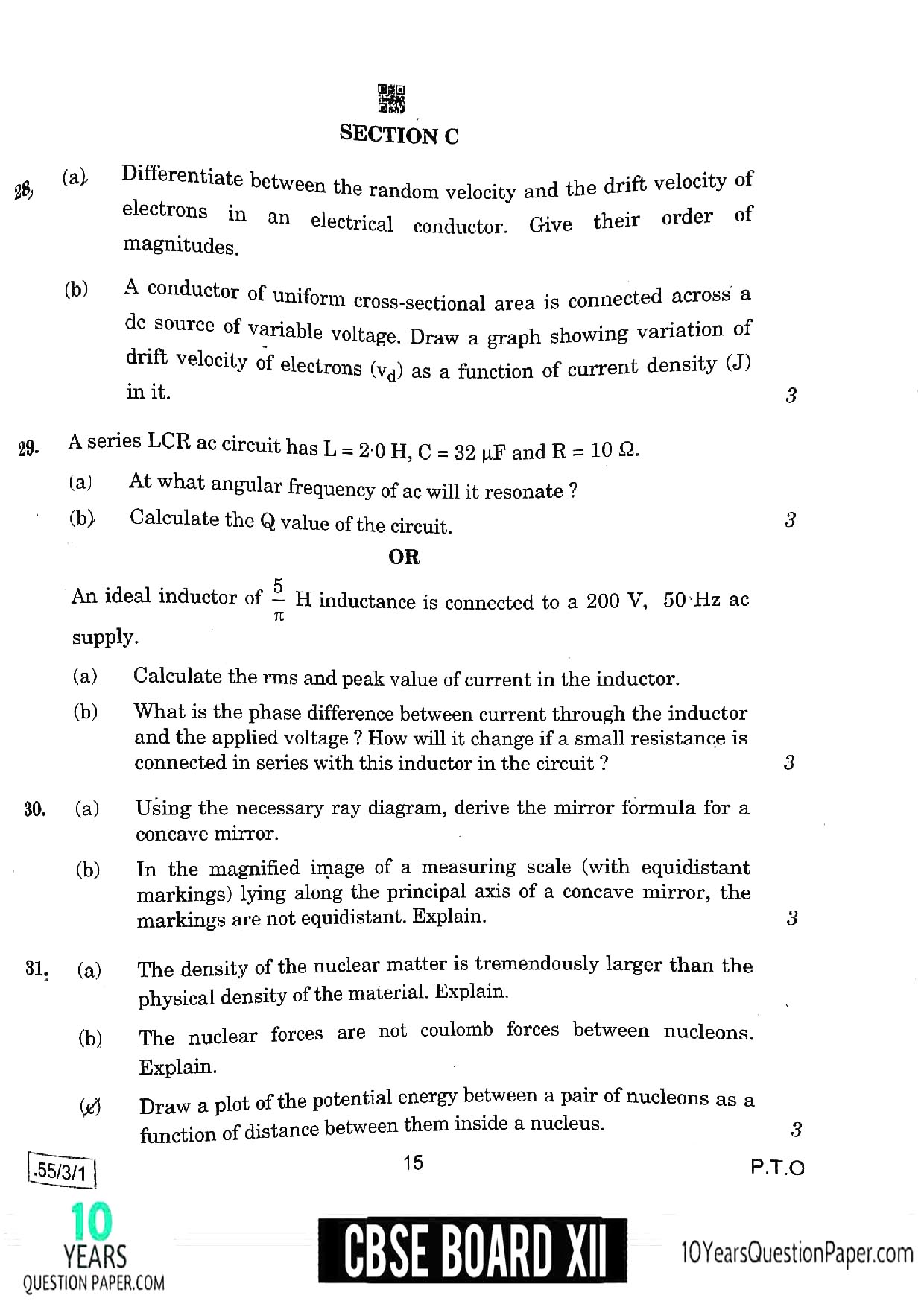
- A series LCR ac circuit has L = 2.0 H, C = 32 μF and R = 10 Ω. At what angular frequency will it resonate, and what is the Q value of the circuit?
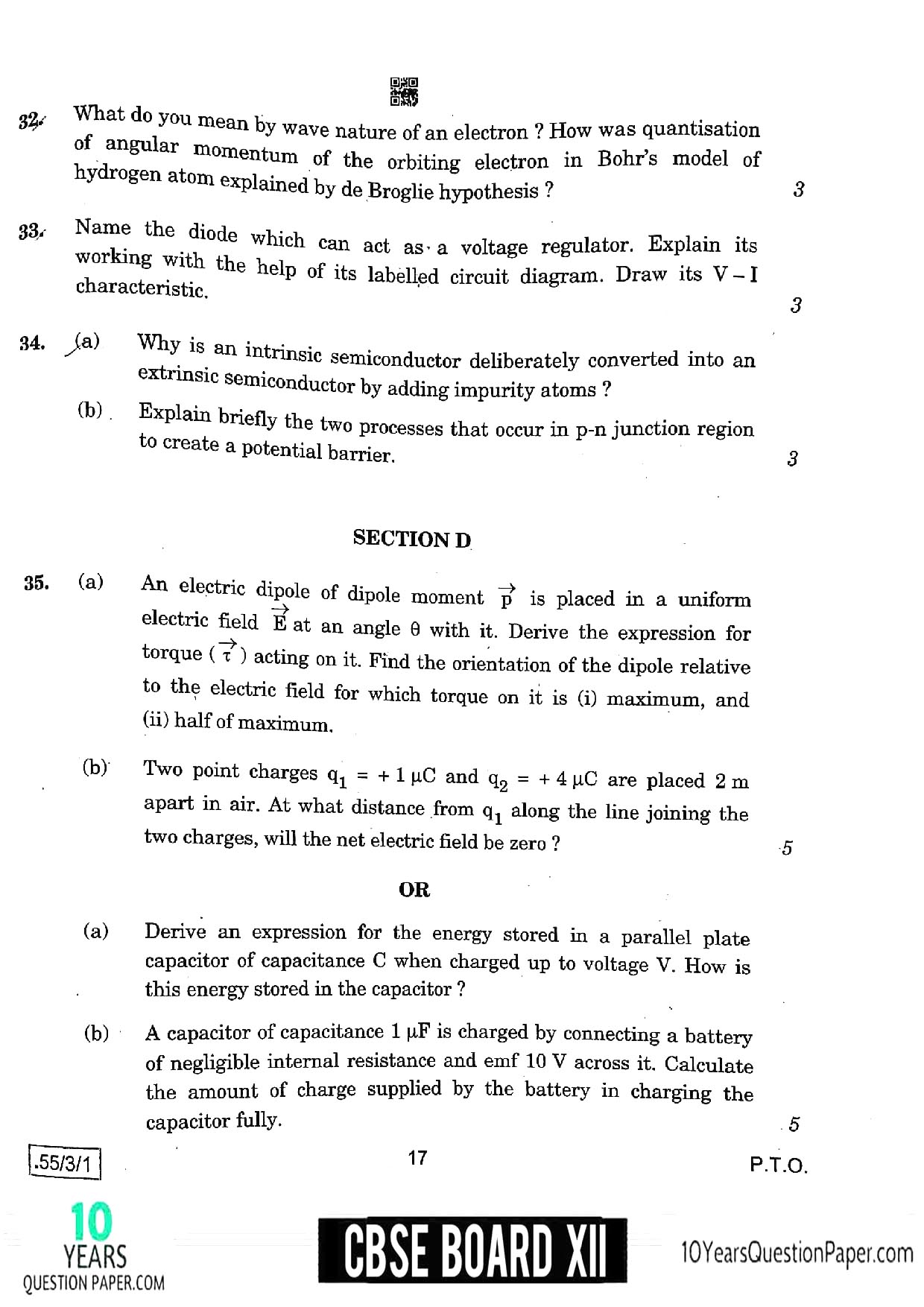
- Name the diode which can act as a voltage regulator. Explain its working with the help of a labelled circuit diagram and draw its V–I characteristic.
- Two point charges q₁ = +1 μC and q₂ = +4 μC are placed 2 m apart in air. At what distance from q₁ along the line joining the two charges will the net electric field be zero?
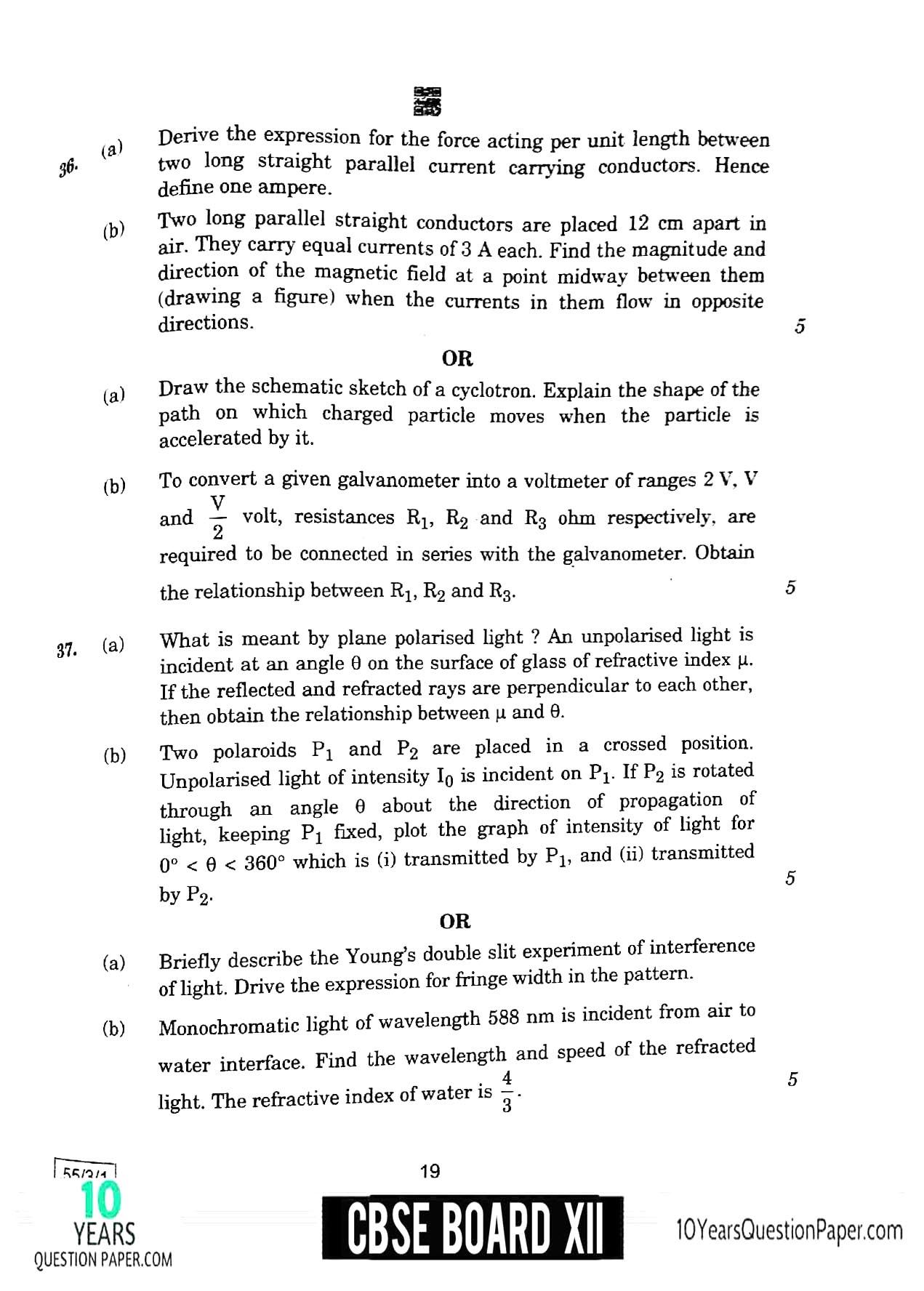
- Two long parallel straight conductors are placed 12 cm apart in air and carry equal currents of 3 A each in opposite directions. Find the magnitude and direction of the magnetic field at a point midway between them.
Free email alert
Get the 2027 CBSE Class 12 papers first
One email when the new CBSE Class 12 Physics question papers are published here. No spam, unsubscribe any time.
Download
- Format
- Size
- N/A
- Pages
- 9
What's next
Planning what comes after Class 12?
Compare college costs, education loans, and scholarships in one place.
See the cost breakdown