CBSE Class 12 Chemistry Question Paper 2020 with Solution

CBSE
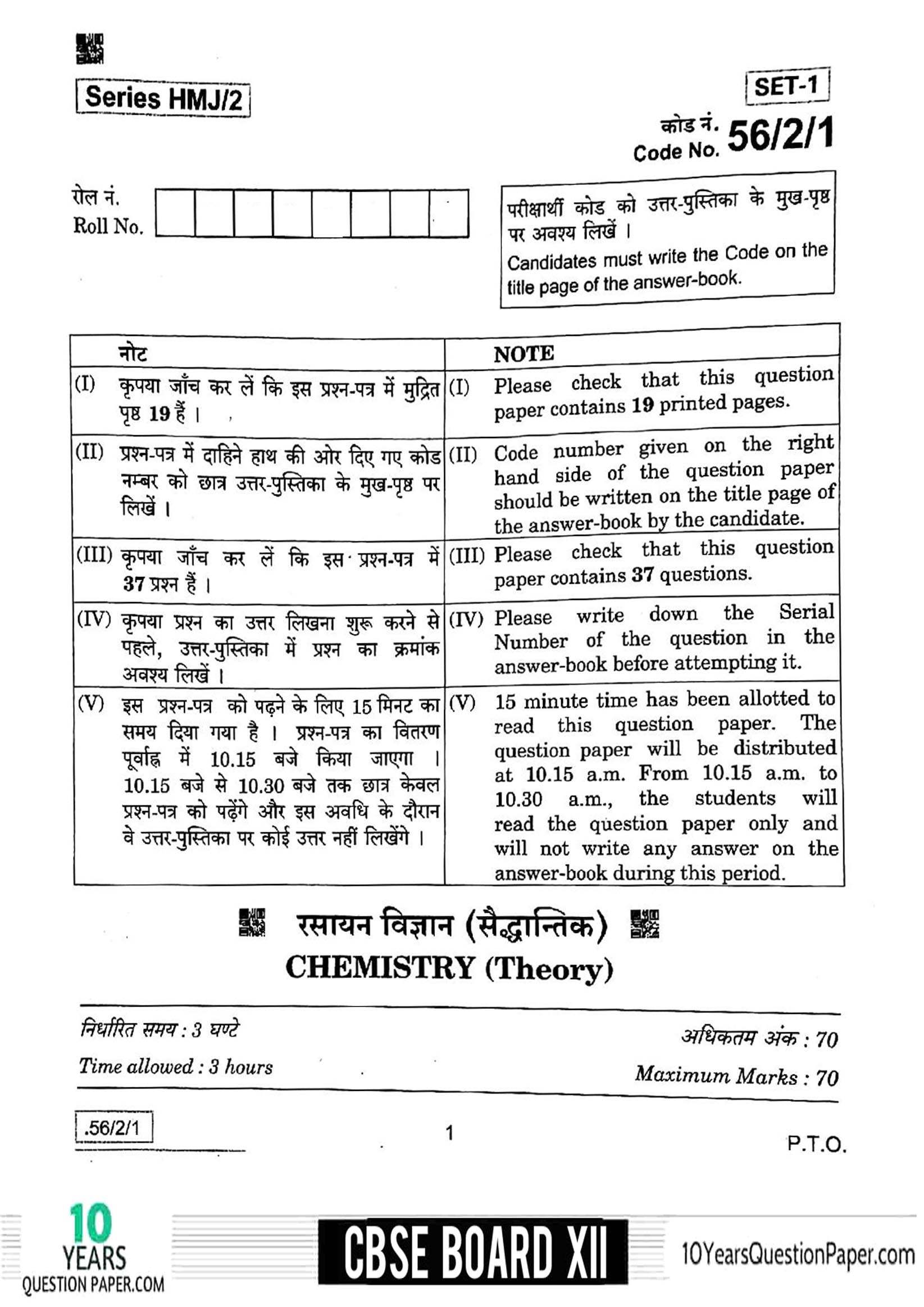
Chemistry2020CBSE Class 12 Chemistry 2020 question paper (code 56/2/1): 37 questions in four sections for 70 marks in 3 hours, with MCQs and assertion–reason. No answers.
Practice these questions to improve your performance in the board examination.
About this paper
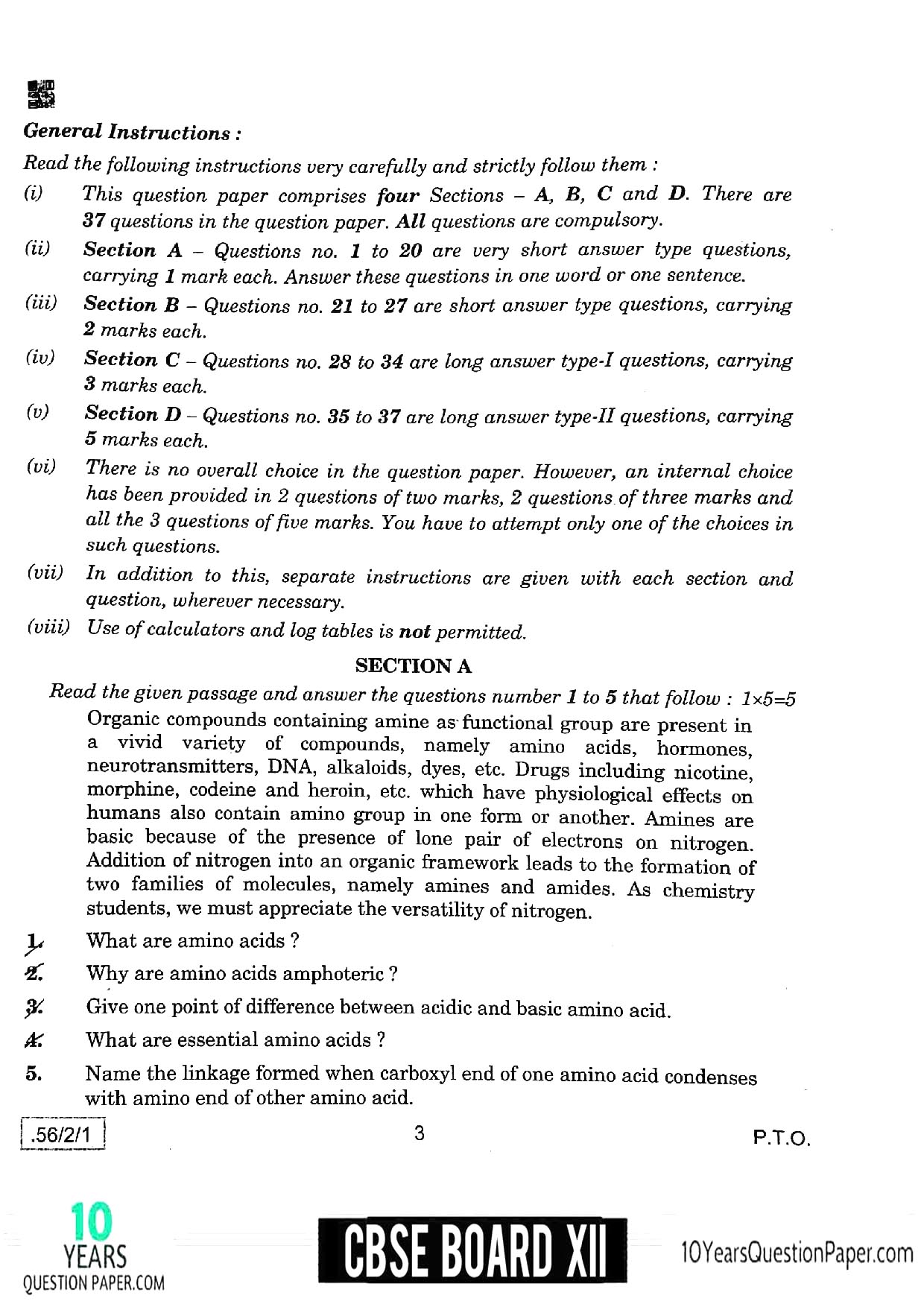
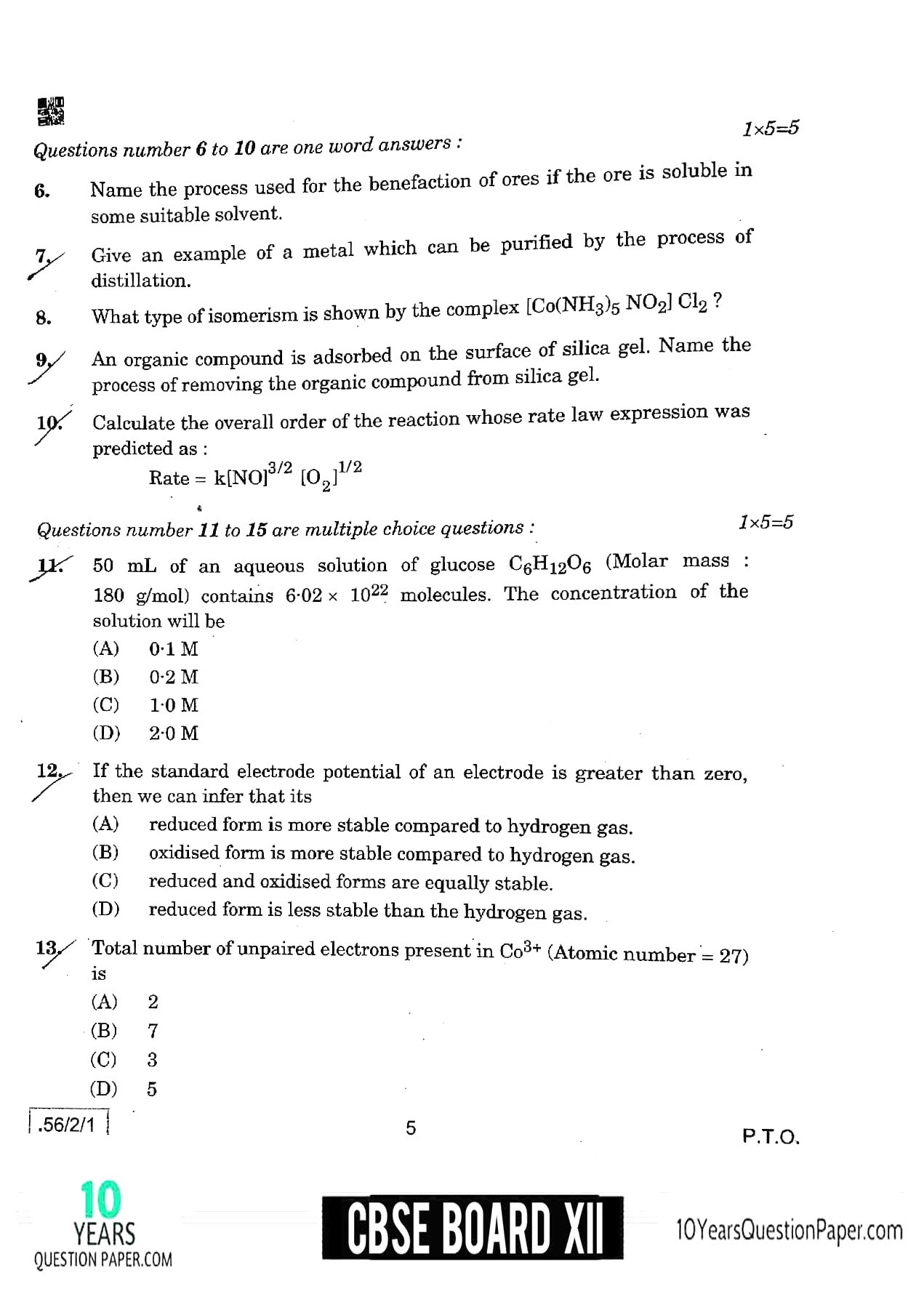
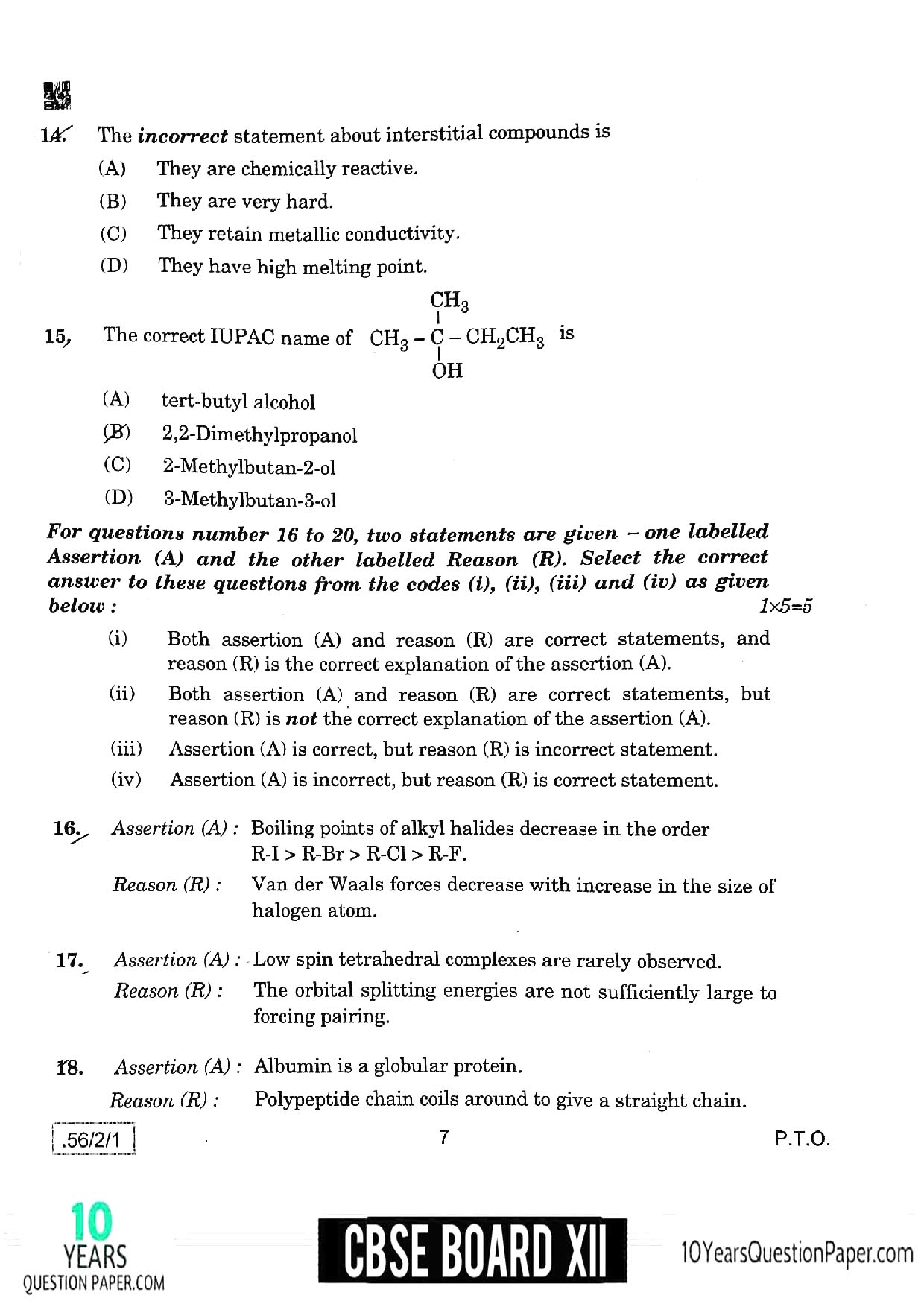
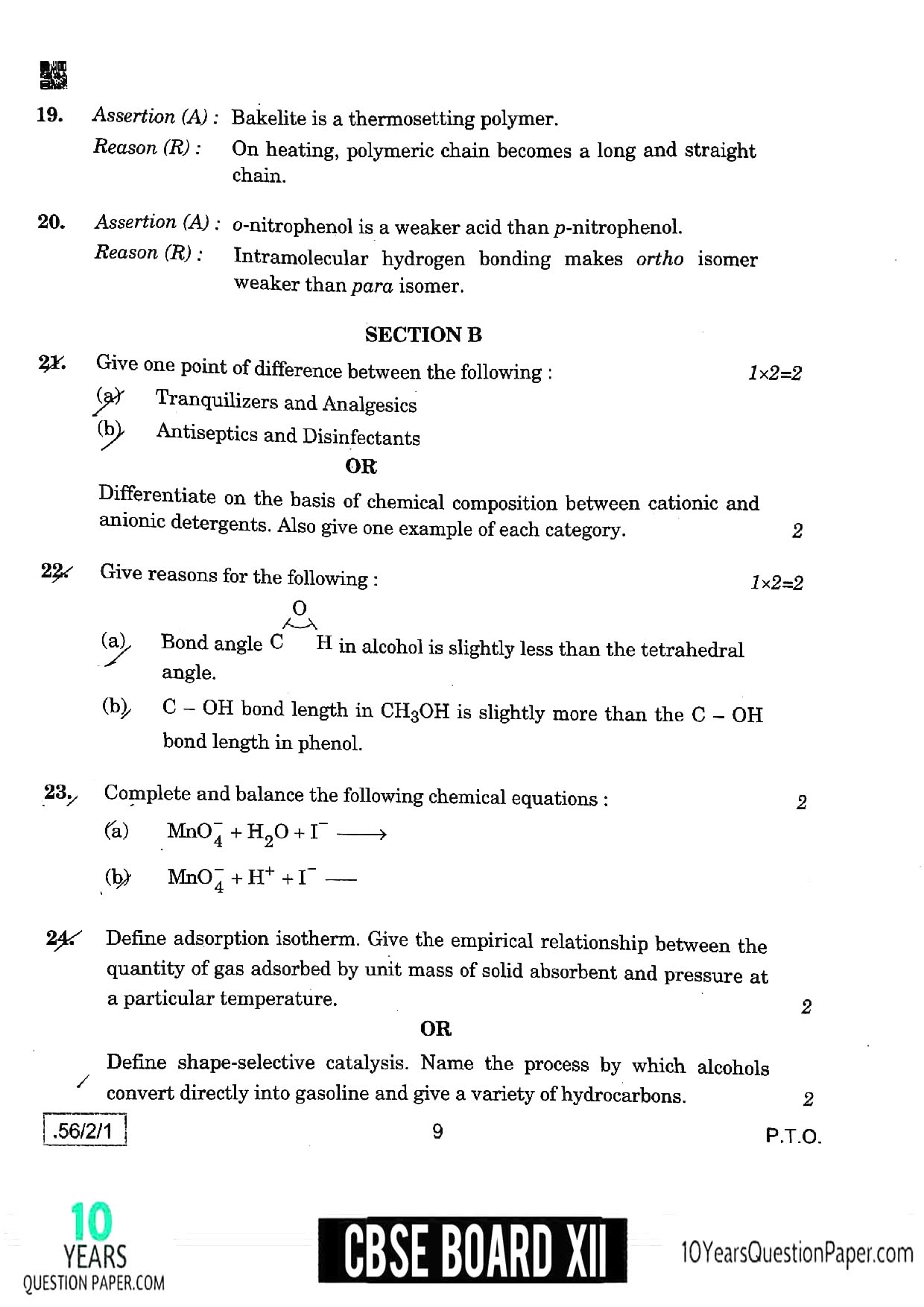
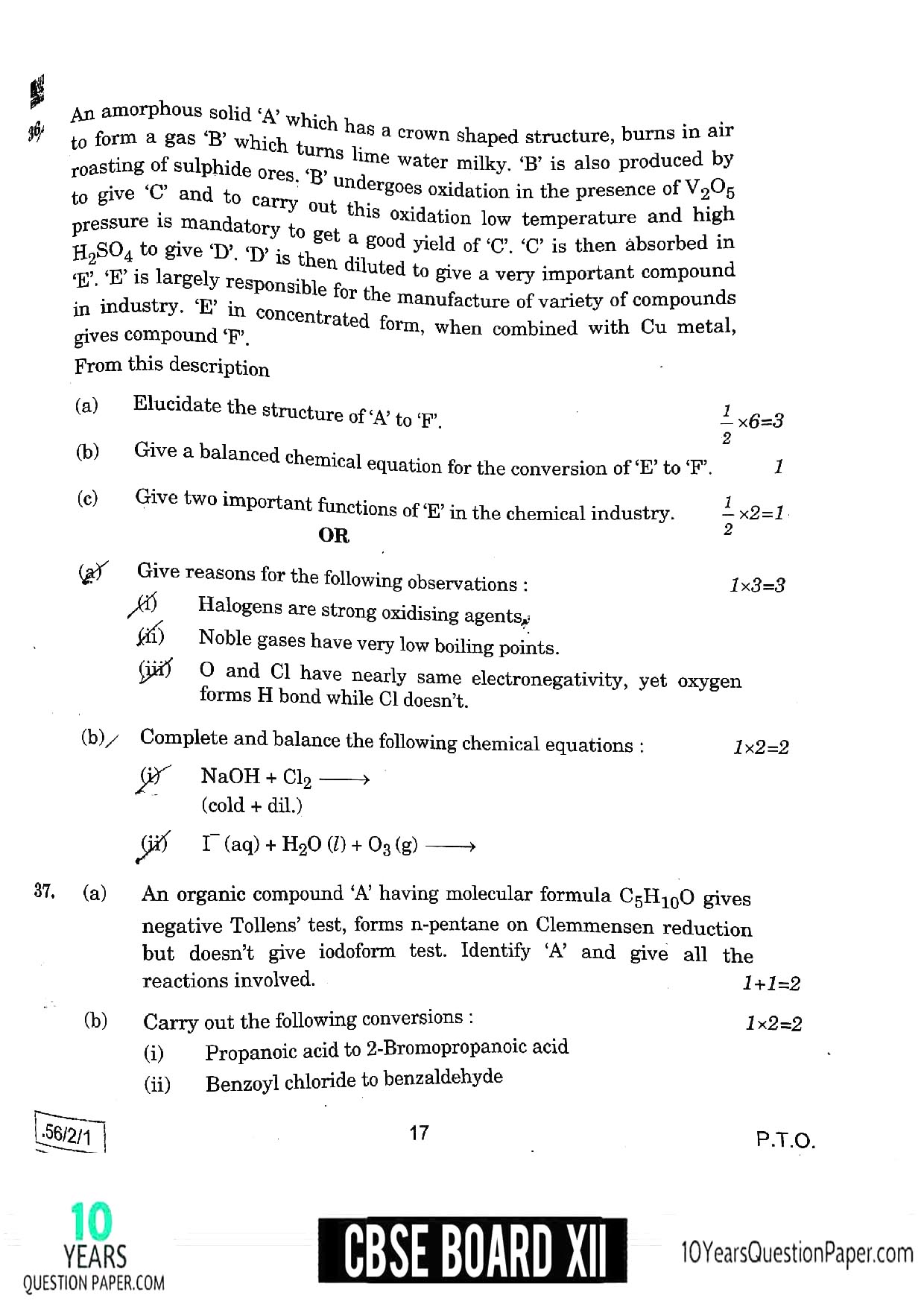
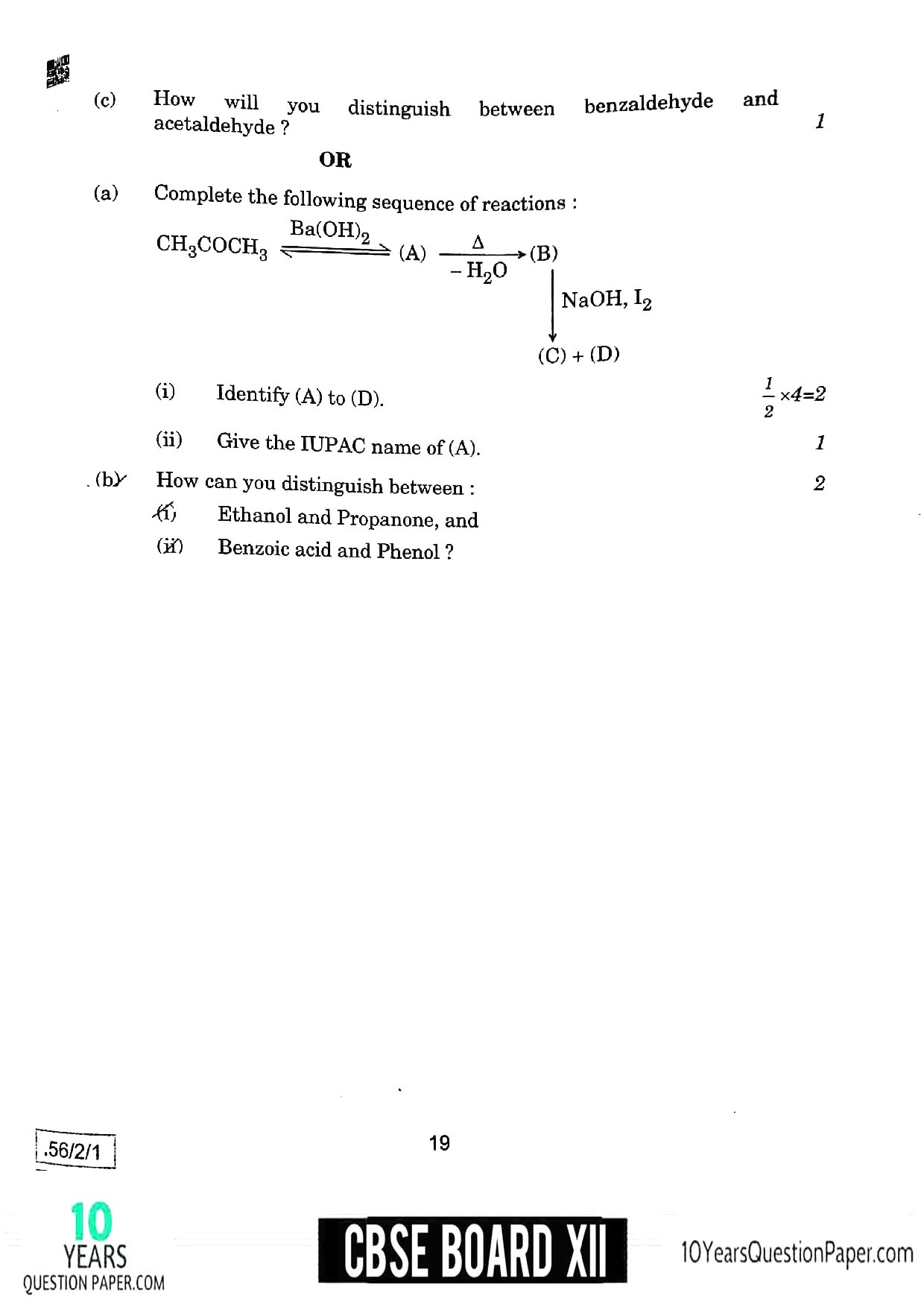
This is the CBSE Class 12 Chemistry (Theory) question paper code 56/2/1, Series HMJ/2, Set 1, from the 2020 board examination. It carries 70 marks over three hours and has 37 compulsory questions in four sections. Section A has twenty one-mark items: a passage on amines and amino acids with five questions, five one-word answers, five multiple-choice questions and five assertion–reason questions. Sections B, C and D have two-, three- and five-mark questions; one five-mark question asks you to identify a chain of compounds that starts from crown-shaped sulphur and leads to sulphuric acid. Internal choices are given in two two-mark, two three-mark and all three five-mark questions. Calculators and log tables are not permitted. This copy has the questions only, without solutions.
- Exam
- CBSE Class 12
- Subject
- Chemistry
- Year
- 2020
- Paper code
- 56/2/1
- Maximum marks
- 70
- Time allowed
- 3 hours + 15 min reading
- Questions
- 37
- Pages
- 10
- Answers included
- No, questions only
Paper pattern
Section A
20 marksQuestions 1–20, one mark each: a five-question passage on amino acids, five one-word answers, five multiple-choice and five assertion–reason questions
Section B
14 marksQuestions 21–27, short answers of two marks each; internal choice in two
Section C
21 marksQuestions 28–34, long answer type I of three marks each; internal choice in two
Section D
15 marksQuestions 35–37, long answer type II of five marks each, each with an internal choice
Topics covered
- Solutions and colligative properties
- Electrochemistry and conductance
- Chemical kinetics
- Surface chemistry and catalysis
- Isolation of elements
- p-Block elements
- d-Block elements and interstitial compounds
- Coordination compounds
- Haloalkanes, alcohols and phenols
- Aldehydes, ketones and amines
- Biomolecules and polymers
- Chemistry in everyday life
Questions from this paper
- Name the process used for the beneficiation of ores if the ore is soluble in some suitable solvent.
- Define adsorption isotherm. Give the empirical relationship between the quantity of gas adsorbed by unit mass of solid adsorbent and pressure at a particular temperature.
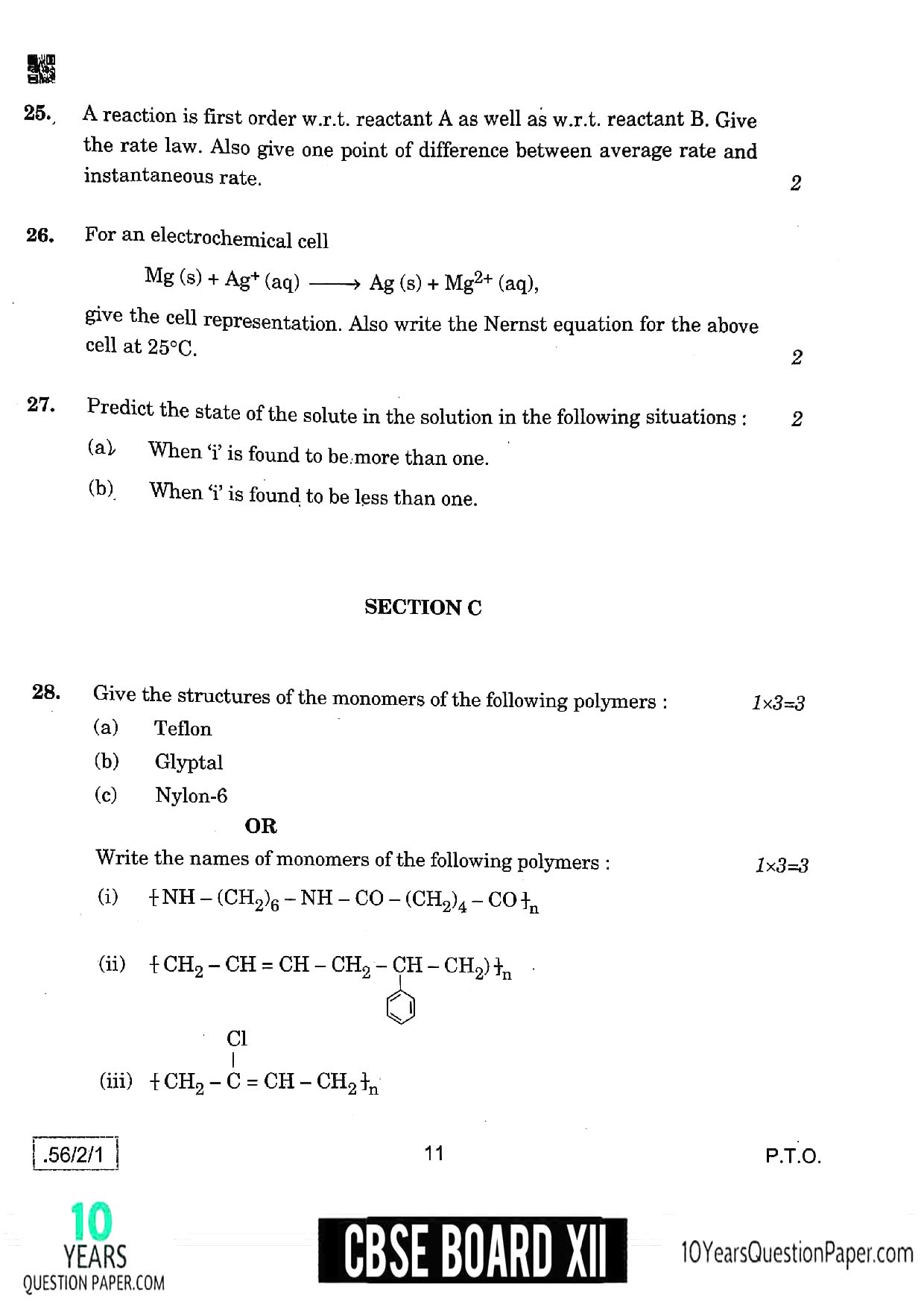
- A reaction is first order with respect to reactant A as well as reactant B. Give the rate law. Also give one point of difference between average rate and instantaneous rate.
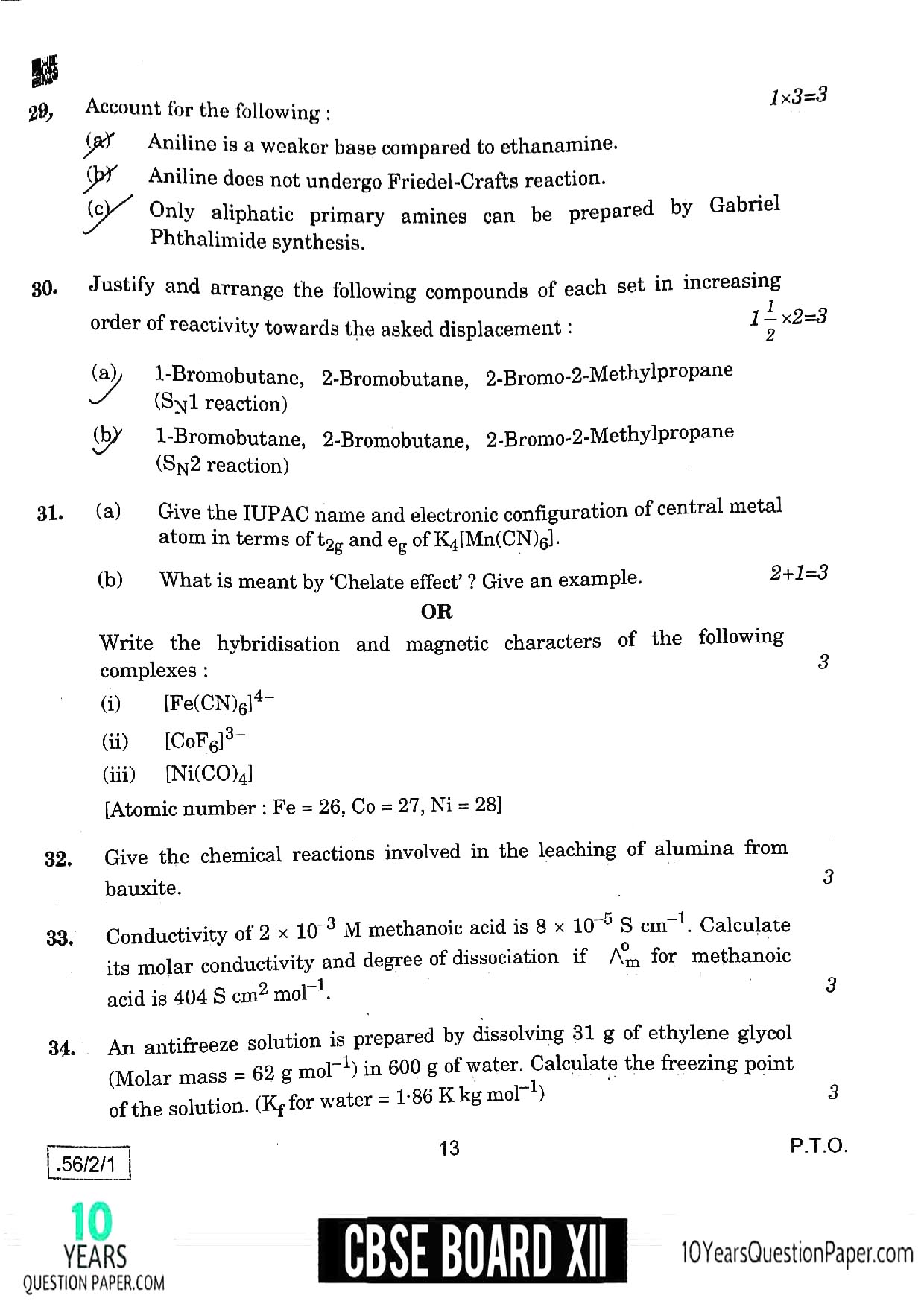
- Give the chemical reactions involved in the leaching of alumina from bauxite.
- An antifreeze solution is prepared by dissolving 31 g of ethylene glycol (molar mass = 62 g mol⁻¹) in 600 g of water. Calculate the freezing point of the solution. (Kf for water = 1.86 K kg mol⁻¹)
- O and Cl have nearly the same electronegativity, yet oxygen forms hydrogen bonds while chlorine does not. Give a reason.
Free email alert
Get the 2027 CBSE Class 12 papers first
One email when the new CBSE Class 12 Chemistry question papers are published here. No spam, unsubscribe any time.
Download
- Format
- Size
- N/A
- Pages
- 10
What's next
Planning what comes after Class 12?
Compare college costs, education loans, and scholarships in one place.
See the cost breakdown