ISC 2016 Chemistry Question Paper for Class 12

ISC
Chemistry2016Download ISC Board Chemistry Question Paper for Class 12 of 2016 year. This Question Paper of Chemistry will help you in revision for the final ISC examination.
Downloaded from www.cisce.org
About this paper
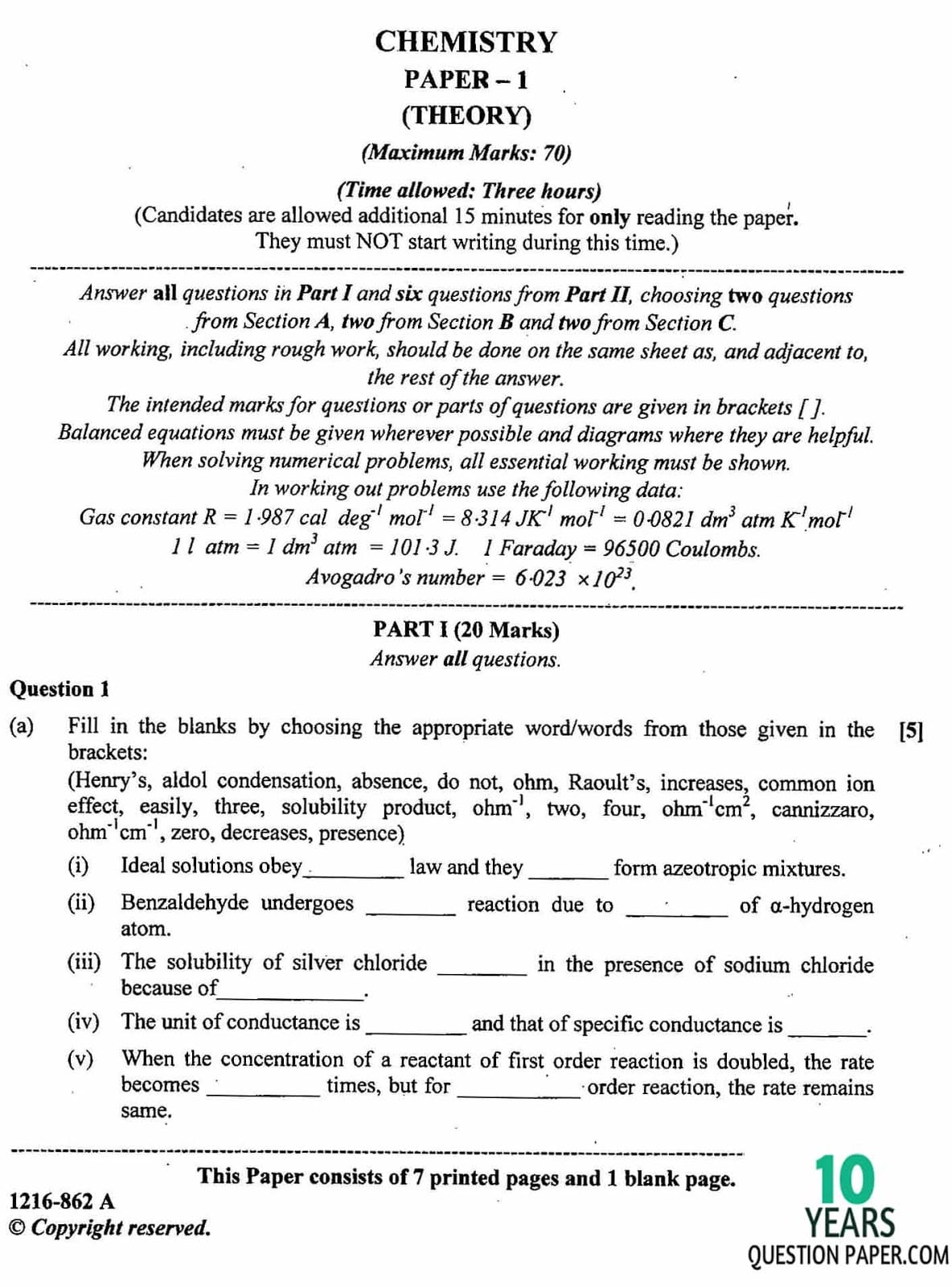
This is ISC Class 12 Chemistry Paper 1 (Theory) from the 2016 CISCE board examination, paper code 862A (printed as 1216-862 A). It carries 70 marks and runs for three hours, with fifteen minutes extra for reading. Part I, of 20 marks, is compulsory. From Part II, of 50 marks, candidates answer six questions: two from Section A, two from Section B and two from Section C. The sections cover physical, inorganic and organic chemistry in that order. Values of R, the Faraday and Avogadro's number are printed for the numericals, and balanced equations are required wherever possible. This copy has the questions only.
- Exam
- ISC Class 12
- Subject
- Chemistry
- Year
- 2016
- Paper code
- 862A
- Maximum marks
- 70
- Time allowed
- 3 hours + 15 min reading
- Questions
- 10
- Pages
- 7
- Answers included
- No, questions only
Paper pattern
Part I
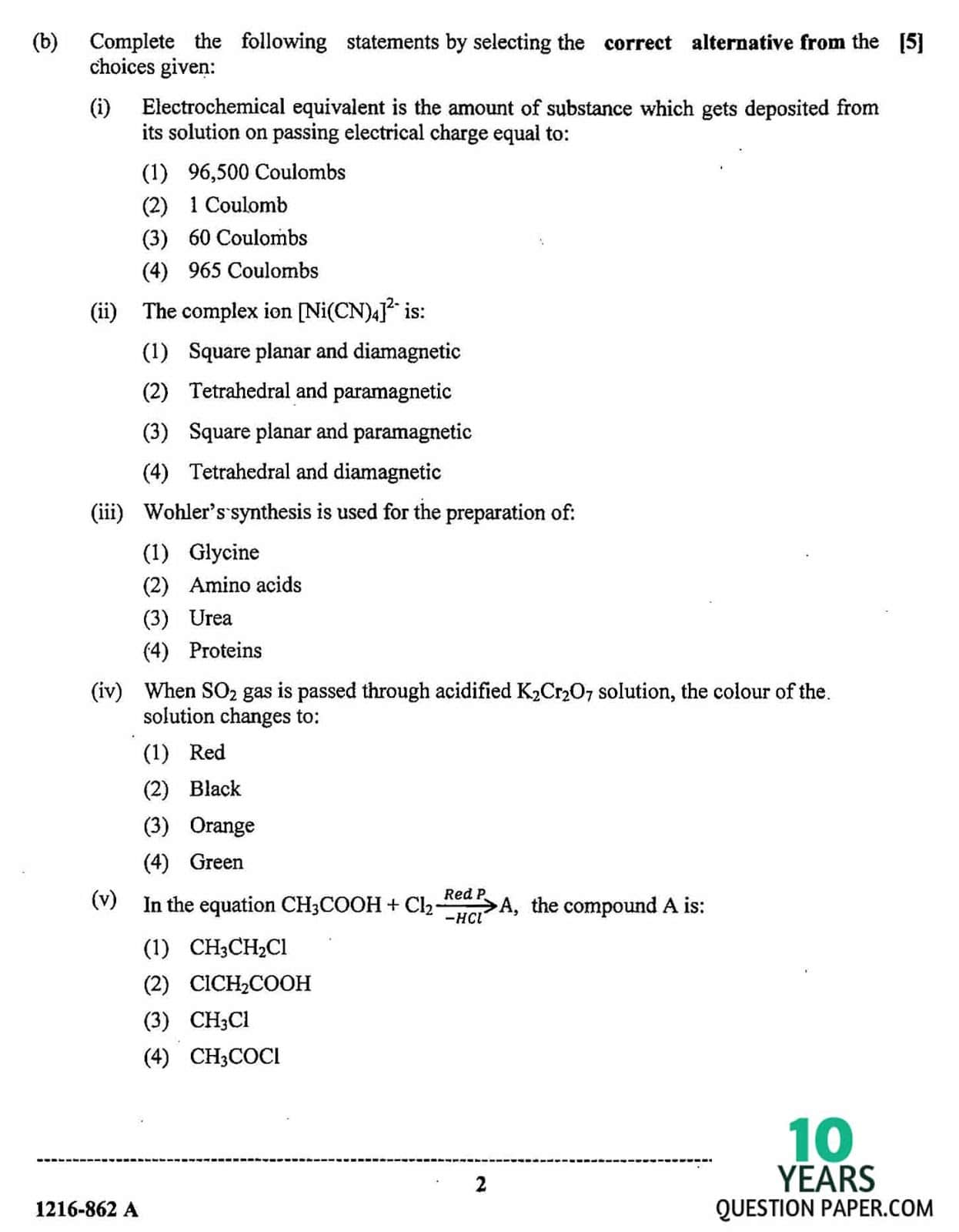
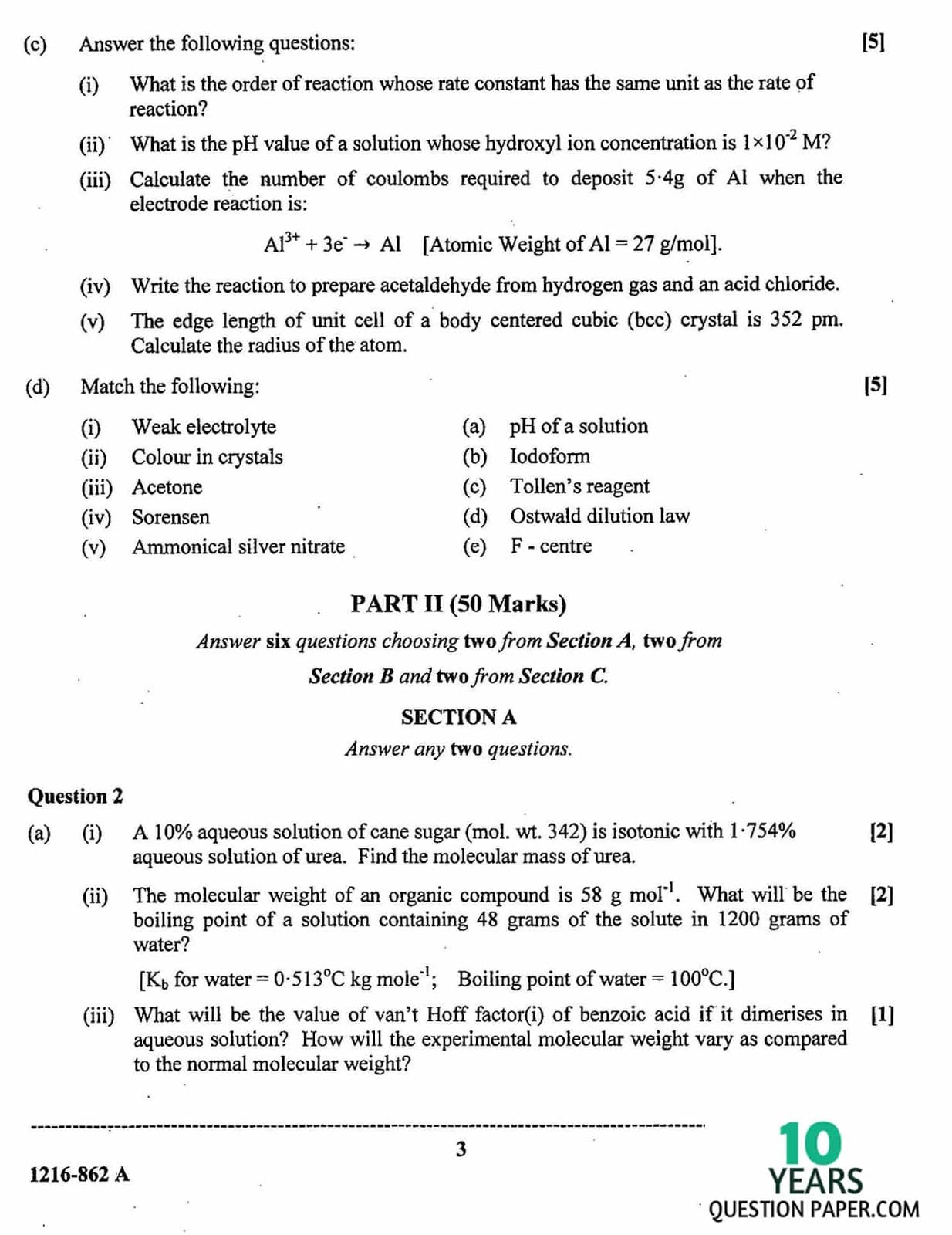
20 marksQuestion 1 is compulsory: five fill-in-the-blanks, five multiple-choice items, five short answers and a five-point match
Section A
20 marksQuestions 2–4 on physical chemistry, 10 marks each; answer any two
Section B
10 marksQuestions 5–7 on coordination compounds, the p-block and lanthanides, 5 marks each; answer any two
Section C
20 marksQuestions 8–10 on organic chemistry, 10 marks each; answer any two
Topics covered
- Solutions and colligative properties
- Chemical kinetics
- Electrochemistry and conductance
- Ionic equilibrium
- Solid state
- Coordination compounds
- p-block elements
- Potassium permanganate
- Lanthanide contraction
- Organic name reactions
- Carbonyl compounds and ethers
- Carbohydrates, polymers and amines
Questions from this paper
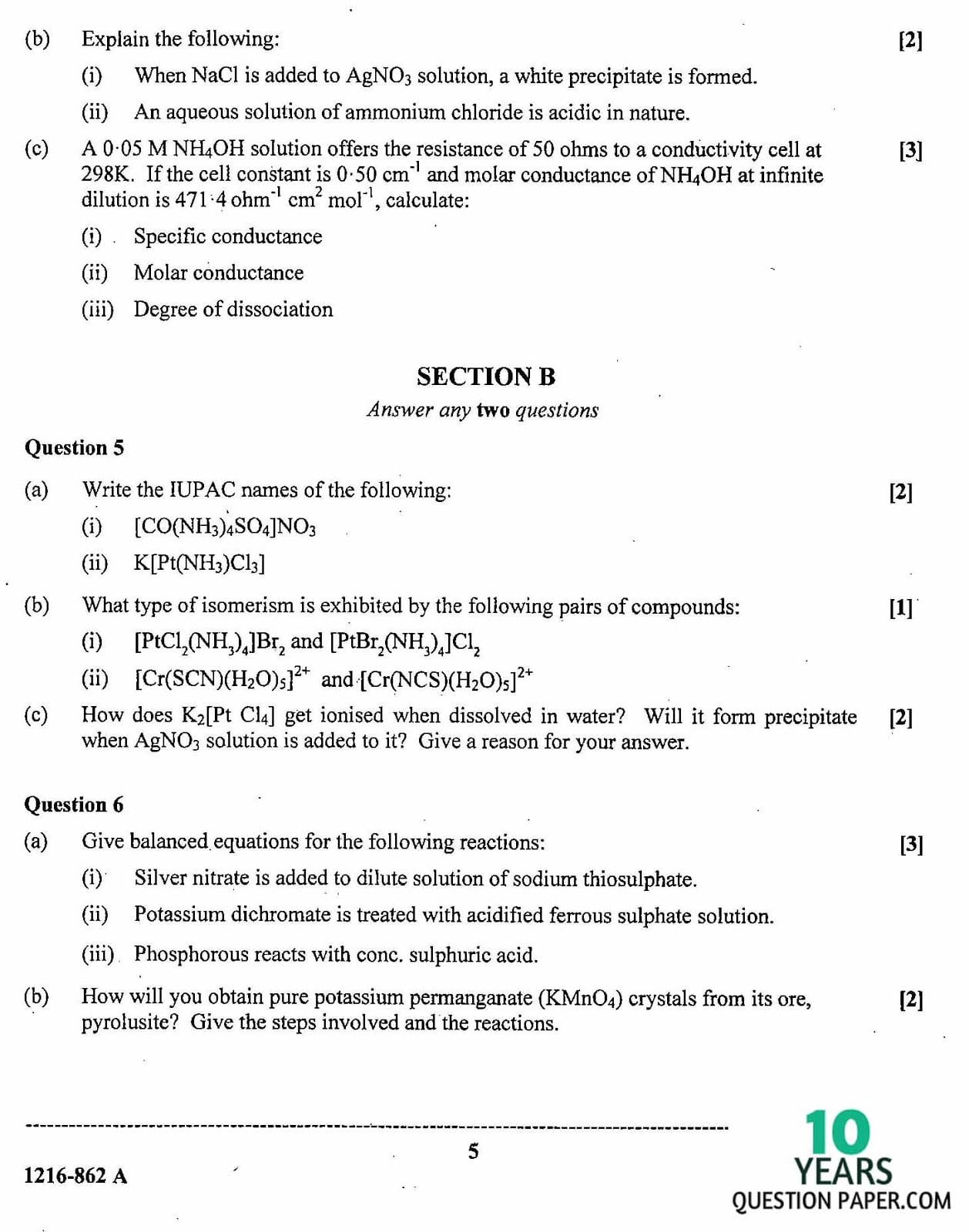
- A 10% aqueous solution of cane sugar (molecular weight 342) is isotonic with a 1.754% aqueous solution of urea. Find the molecular mass of urea.
- What is the boiling point of a solution of 48 g of a solute of molecular weight 58 g mol⁻¹ in 1200 g of water? (Kb for water = 0.513°C kg mol⁻¹; boiling point of water = 100°C.)
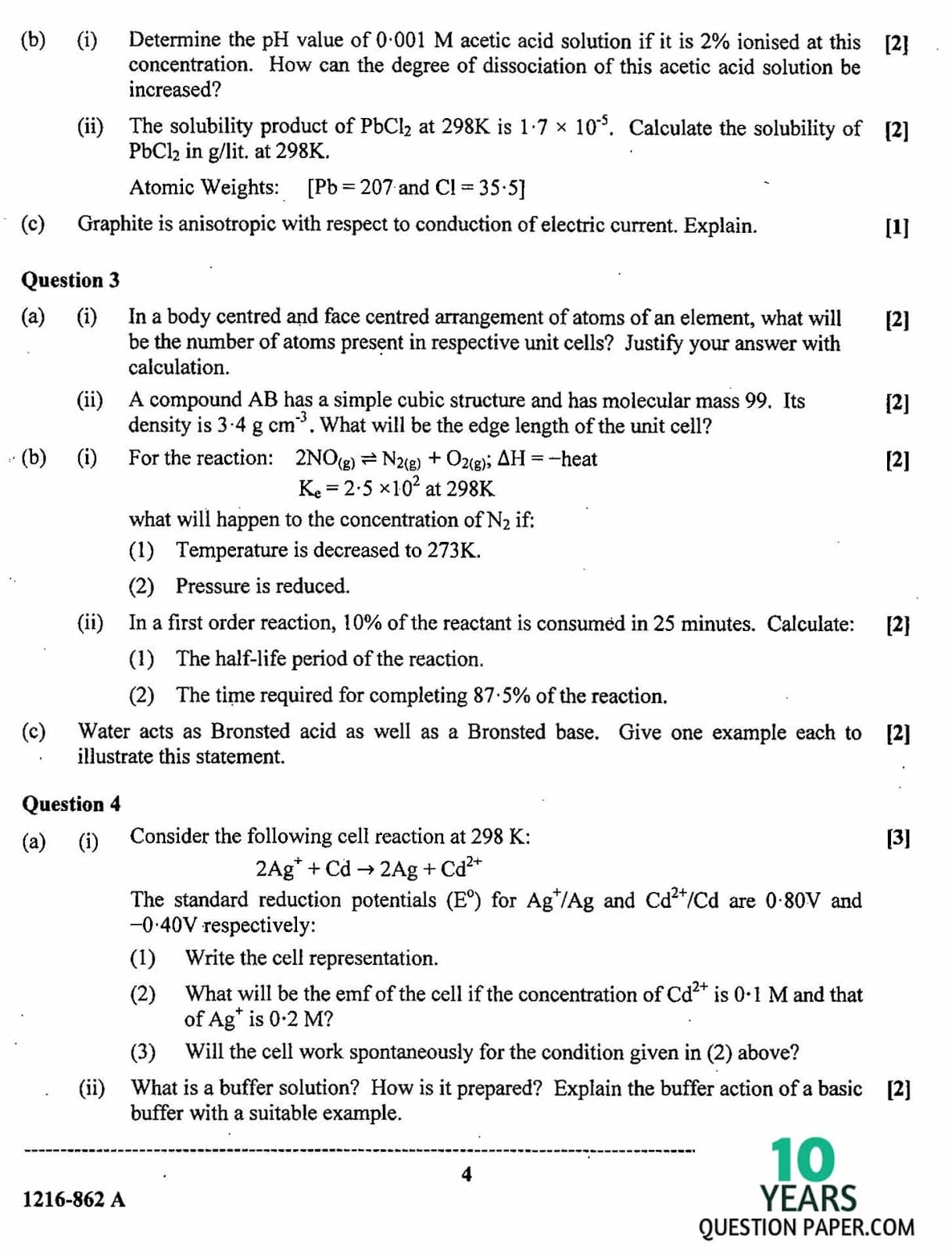
- In a first-order reaction, 10% of the reactant is consumed in 25 minutes. Calculate the half-life and the time needed for 87.5% of the reaction.
- For the cell reaction 2Ag⁺ + Cd → 2Ag + Cd²⁺ at 298 K, E°(Ag⁺/Ag) = 0.80 V and E°(Cd²⁺/Cd) = −0.40 V. Find the emf when [Cd²⁺] = 0.1 M and [Ag⁺] = 0.2 M.
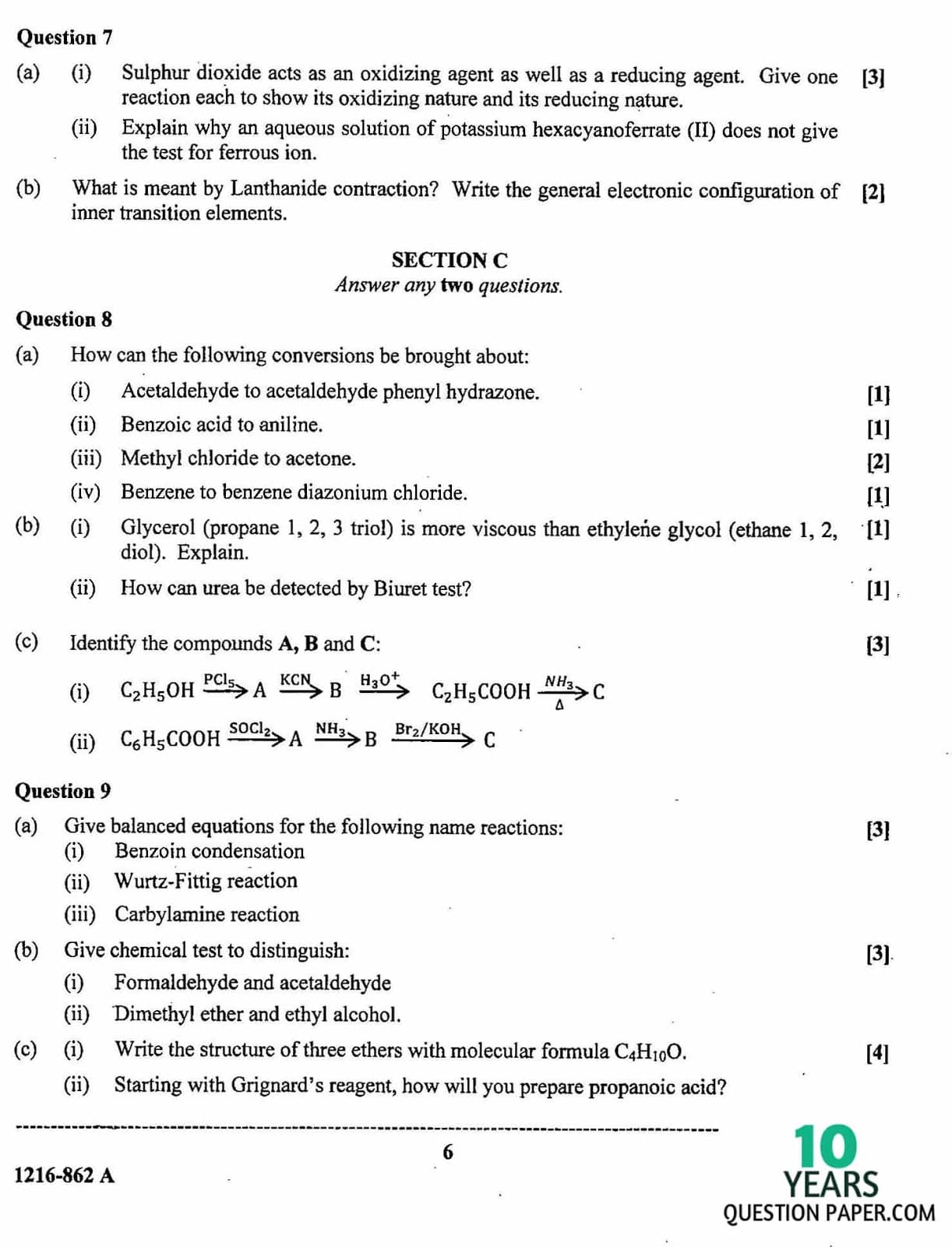
- What is meant by lanthanide contraction? Write the general electronic configuration of the inner transition elements.
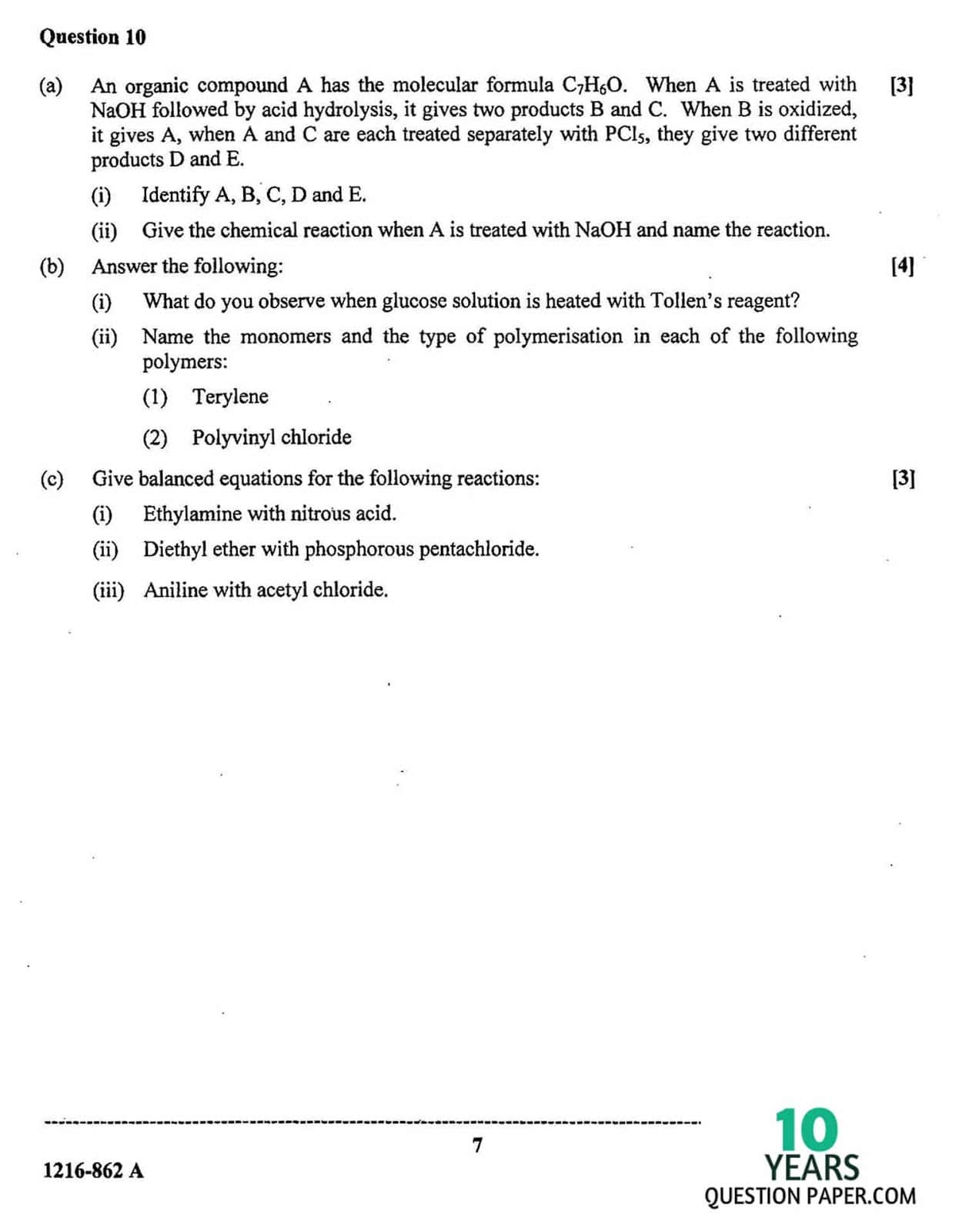
- An organic compound A of formula C₇H₆O, treated with NaOH and then acid, gives B and C. Oxidation of B gives A again. Identify A, B, C, D and E, and name the reaction of A with NaOH.
Free email alert
Get the 2027 ISC Class 12 papers first
One email when the new ISC Class 12 Chemistry question papers are published here. No spam, unsubscribe any time.
What's next
Engineering, medicine, or abroad after ISC?
See what a degree actually costs before you shortlist colleges.
See the cost breakdown