CBSE 2017 Chemistry Solved Paper for Class 12

CBSE
Chemistry2017CBSE Class 12 Chemistry 2017 paper (code 56/1) with worked solutions by Career Point, Kota: 26 questions for 70 marks in 3 hours, with a value-based question.
Practice these questions to improve your performance in the board examination.
About this paper
This is the CBSE Class 12 Chemistry question paper code 56/1 (Series GBM, Set 1) from the 2017 board examination, with a worked solution under every question. The solutions are by Career Point, Kota, whose name appears in the page footers. The paper carries 70 marks over three hours and has 26 compulsory questions: five one-mark, five two-mark, twelve three-mark, one four-mark value-based question and three five-mark long answers. The value-based question is about a student who campaigns against potassium bromate and iodate in bakery products. Internal choices appear in several questions, and the long answers cover the d-block, solutions and carbonyl compounds. Calculators are not allowed; log tables may be used.
- Exam
- CBSE Class 12
- Subject
- Chemistry
- Year
- 2017
- Paper code
- 56/1
- Maximum marks
- 70
- Time allowed
- 3 hours
- Questions
- 26
- Pages
- 14
- Answers included
- Yes
Paper pattern
Questions 1–5
5 marksVery short answer questions, one mark each
Questions 6–10
10 marksShort answer questions, two marks each; internal choice in one
Questions 11–22
36 marksShort answer questions, three marks each; internal choice in one
Question 23
4 marksValue-based question
Questions 24–26
15 marksLong answer questions, five marks each, each with an internal choice
Topics covered
- Solid state
- Solutions and colligative properties
- Electrochemistry
- Chemical kinetics
- Surface chemistry and colloids
- Isolation of elements
- p-Block elements
- d- and f-Block elements
- Coordination compounds
- Haloalkanes, alcohols and phenols
- Aldehydes, ketones, carboxylic acids and amines
- Biomolecules, polymers and chemistry in everyday life
Questions from this paper
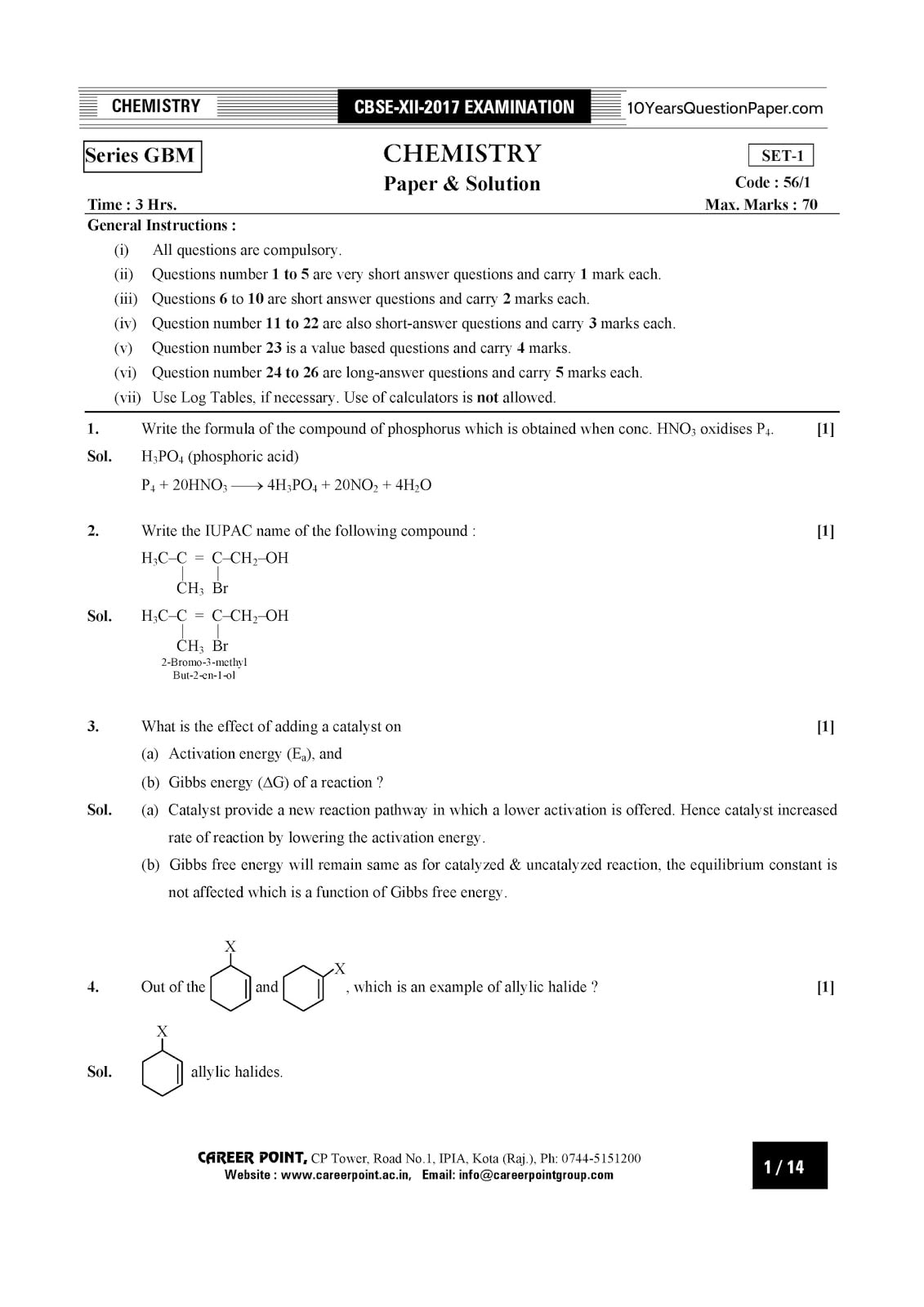
- What is the effect of adding a catalyst on (a) the activation energy (Ea) and (b) the Gibbs energy (ΔG) of a reaction?
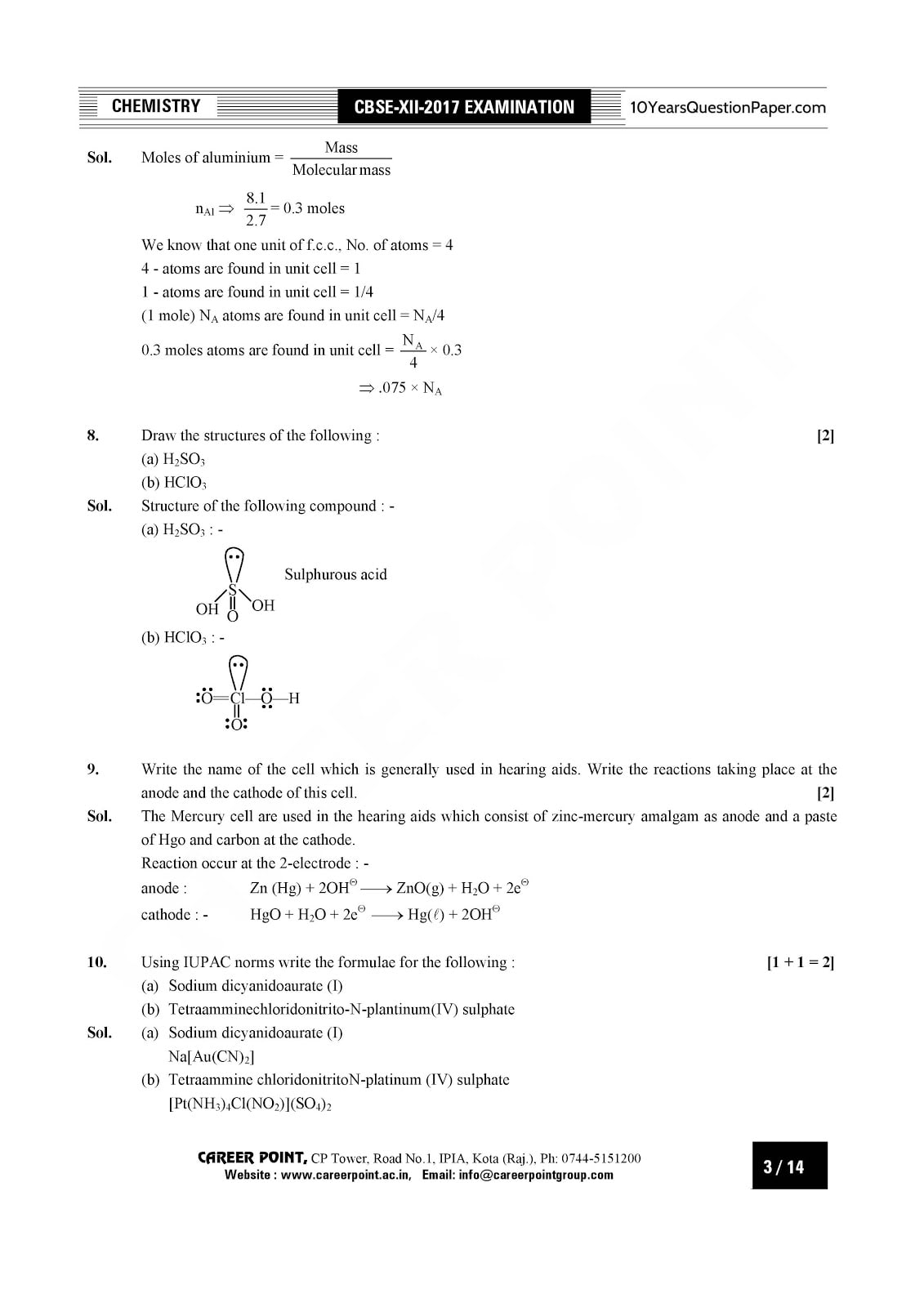
- Calculate the number of unit cells in 8.1 g of aluminium if it crystallises in a face-centred cubic (f.c.c.) structure. (Atomic mass of Al = 27 g mol⁻¹)
- Write the name of the cell which is generally used in hearing aids. Write the reactions taking place at the anode and the cathode of this cell.
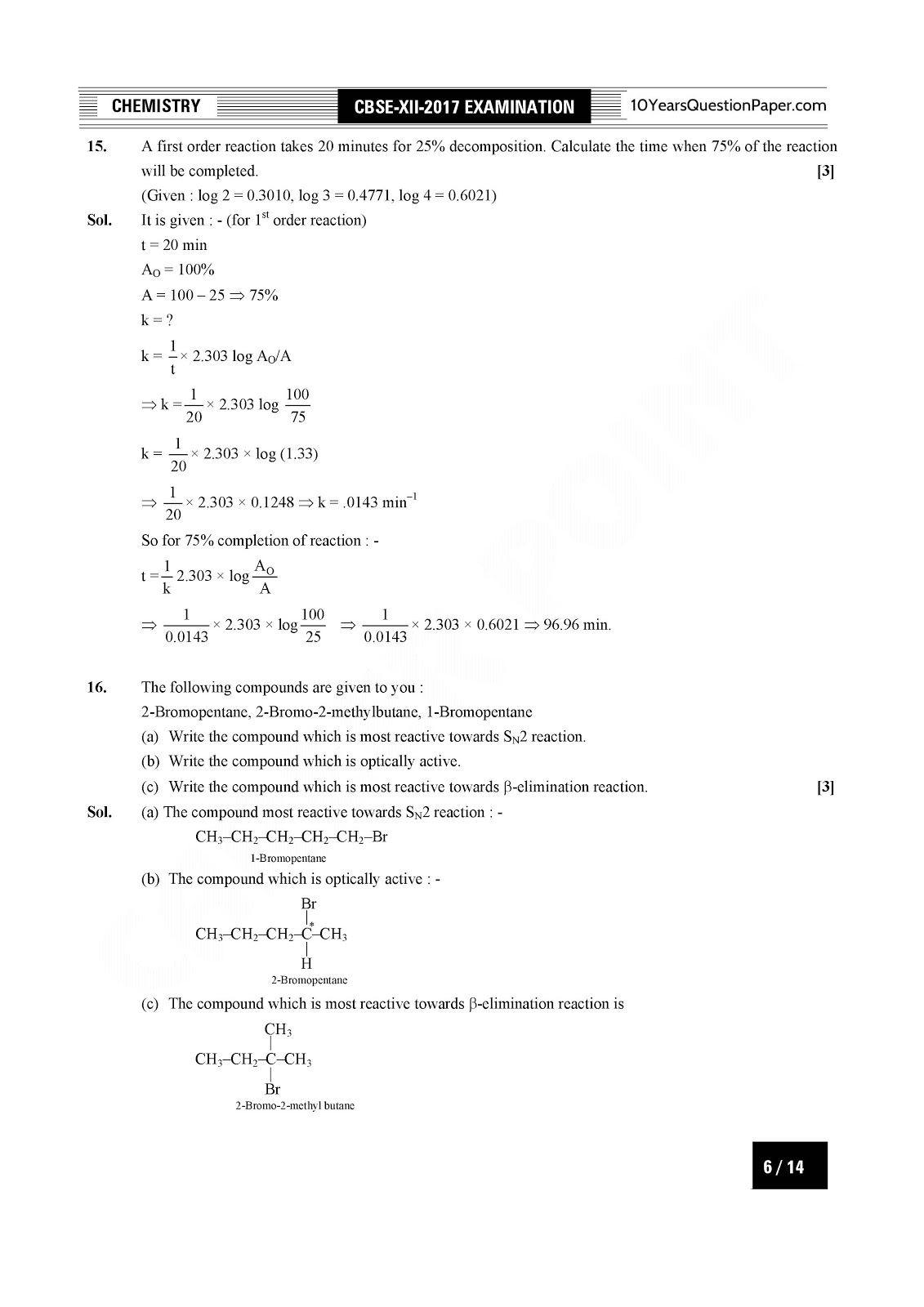
- A first order reaction takes 20 minutes for 25% decomposition. Calculate the time when 75% of the reaction will be completed.
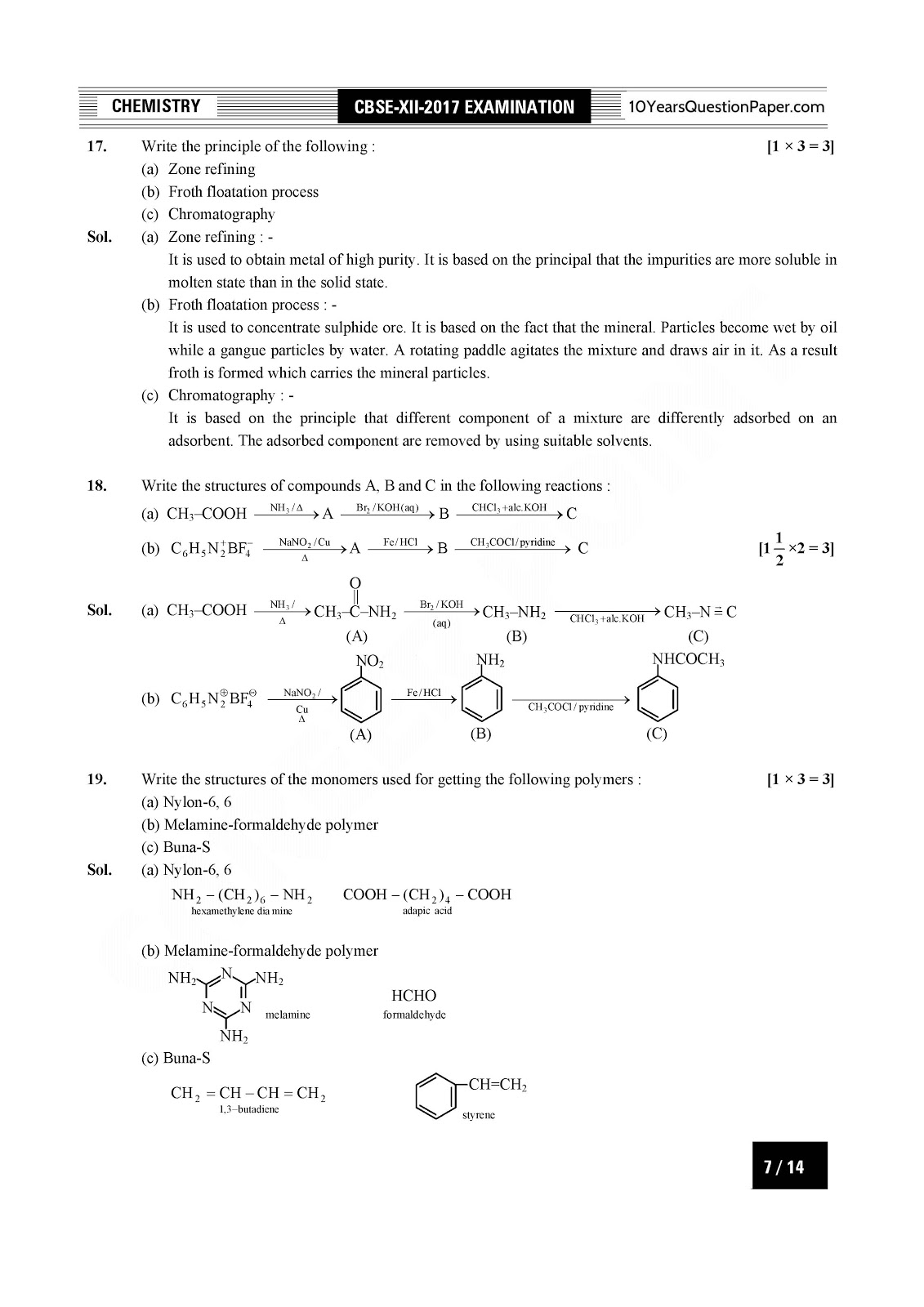
- Write the principle of (a) zone refining, (b) the froth floatation process and (c) chromatography.
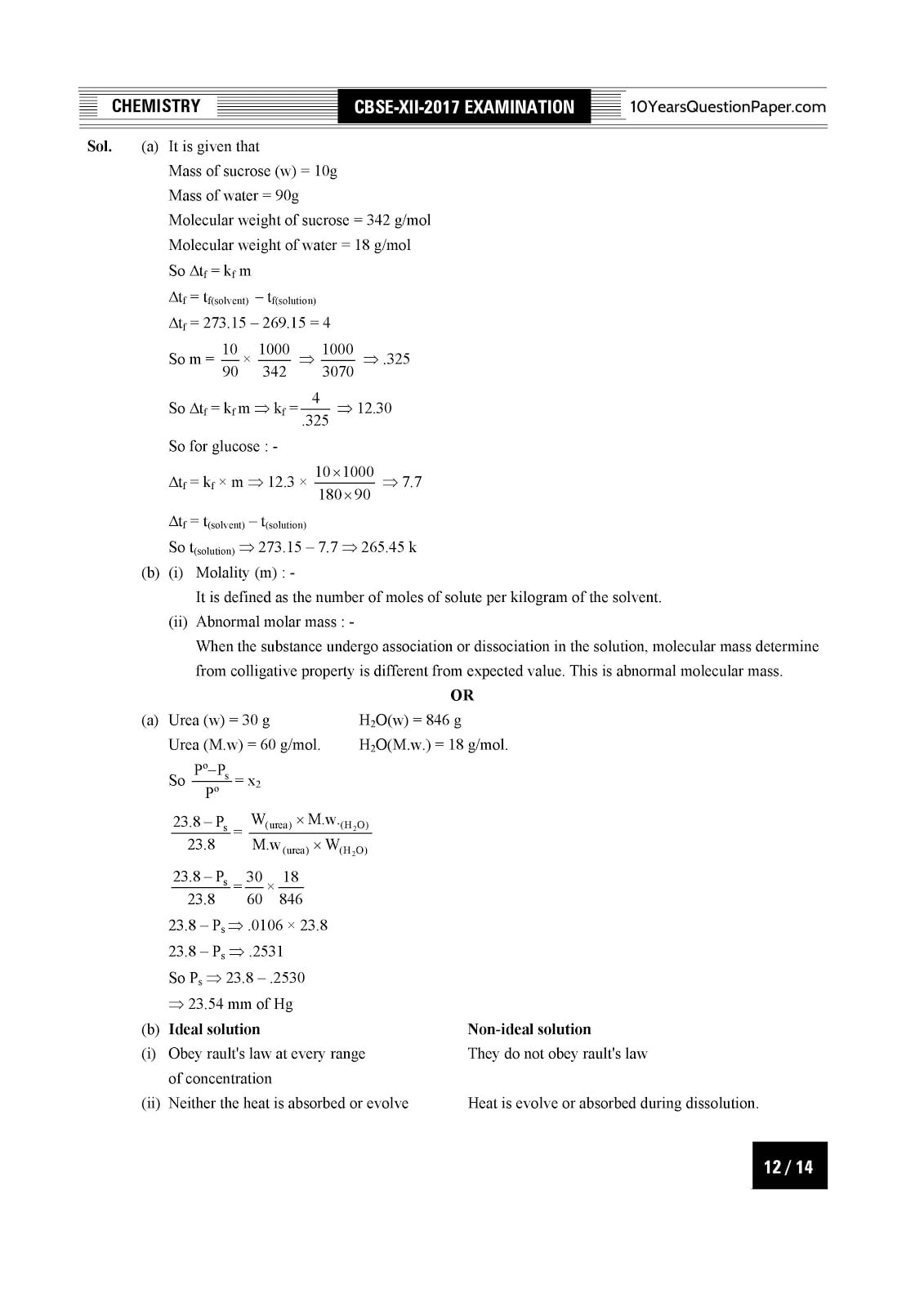
- A 10% solution (by mass) of sucrose in water has a freezing point of 269.15 K. Calculate the freezing point of 10% glucose in water if the freezing point of pure water is 273.15 K.
Free email alert
Get the 2027 CBSE Class 12 papers first
One email when the new CBSE Class 12 Chemistry question papers are published here. No spam, unsubscribe any time.
What's next
Planning what comes after Class 12?
Compare college costs, education loans, and scholarships in one place.
See the cost breakdown